
Detailed Guide on How to Write a Registered Nurse Resume
Review a registered nurse resume example, then build a targeted version with AI or check your current resume score.
Professional Summary for Nurses
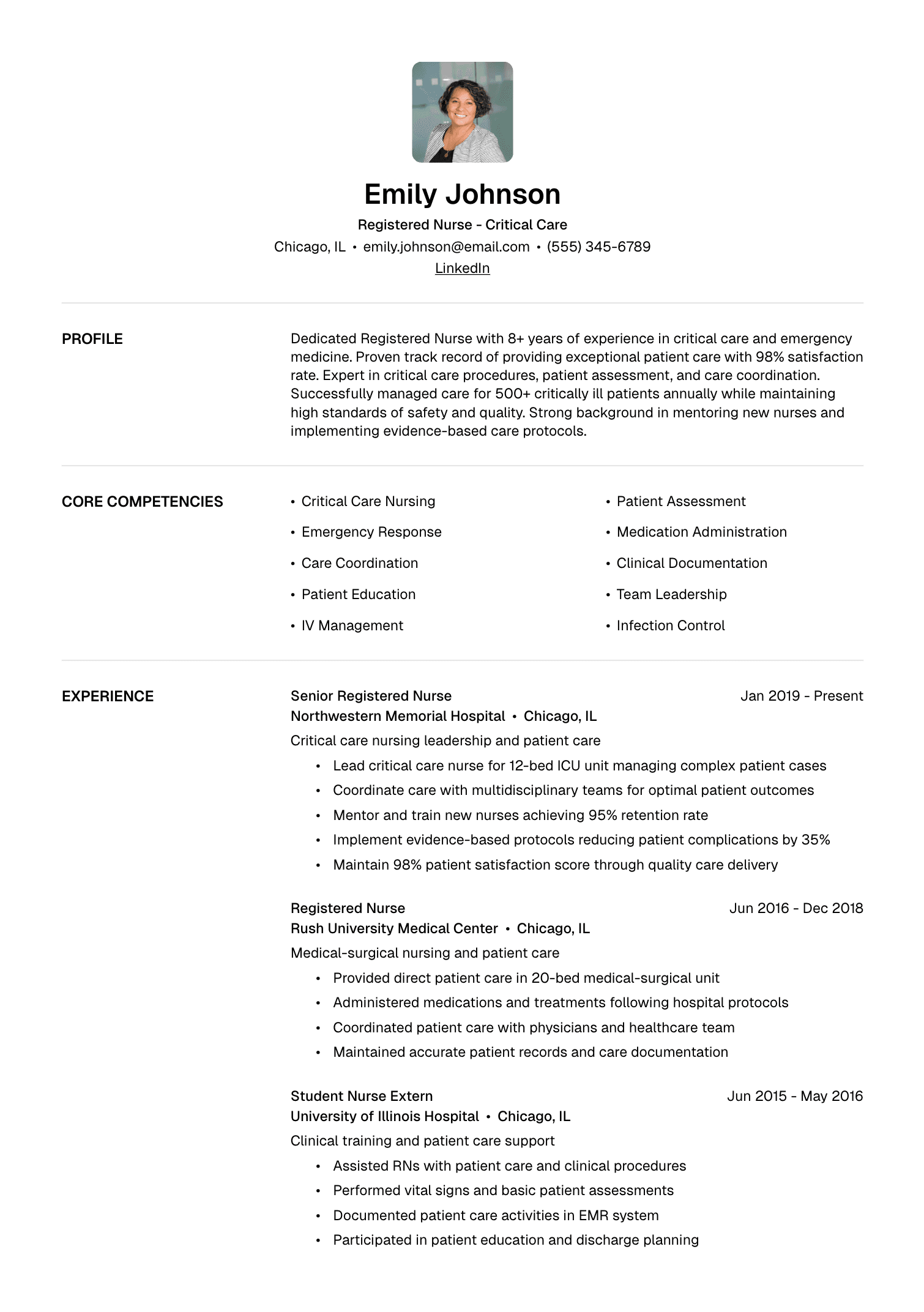
Your professional summary as a nurse must effectively communicate your clinical expertise and dedication to patient care. This crucial section needs to immediately capture attention by highlighting your most significant nursing achievements, specializations, and healthcare experience. For senior roles, focus on leadership and specialized clinical skills; for mid-level positions, emphasize direct patient care experience and unit-specific expertise; for entry-level roles, showcase clinical rotations and relevant certifications. The key is to quantify achievements with concrete metrics while demonstrating compassionate care and technical proficiency. Remember to customize this section based on the specific role and healthcare setting, highlighting relevant specialties and patient populations. The summary should demonstrate not just your clinical skills, but how your care has impacted patient outcomes.
Senior Nurse Summary Guide
For senior roles, your summary should emphasize three key elements: clinical leadership, specialized expertise, and patient care impact. Focus on unit management, staff development, and measurable healthcare outcomes.
Senior Critical Care Nurse Example
Registered Nurse with 8+ years of critical care experience and current CCRN certification.
- Led 15-bed ICU unit achieving 98% patient satisfaction
- Reduced ventilator-associated complications by 30%
- Mentored 20+ new nurses while maintaining unit metrics above national benchmarks for patient safety and care quality
Emergency Department Charge Nurse Example
Emergency Department Charge Nurse with 10+ years of trauma care experience.
- Managed level-1 trauma center team of 25+ nurses
- Implemented evidence-based protocols that reduced ED wait times by 40%
- Improved patient outcomes by 25%
- Recipient of hospital's Nursing Excellence Award for leadership in crisis situations
Lead with your nursing credentials and years of experience
Include specific specializations and certifications
Quantify impact with concrete metrics (patient outcomes, safety improvements)
Highlight both clinical and leadership achievements
Keep it under 4 lines for optimal readability
Mid-Level Nurse Summary Guide
Mid-level nurses should focus on specialized skills and growing clinical expertise. Highlight your direct patient care experience and unit-specific achievements.
Medical-Surgical Nurse Example
Medical-Surgical Nurse with 4 years of experience providing comprehensive care in a 30-bed unit.
- Maintained 100% medication administration accuracy while managing 6-patient assignments
- Recognized for excellence in wound care management
- Reduced unit pressure ulcer rates by 35%
Labor and Delivery Nurse Example
Labor and Delivery Nurse with 3 years of experience in high-risk obstetrics.
- Successfully managed 500+ deliveries including 100+ high-risk cases
- Implemented patient education program reducing C-section rates by 15%
- Improved maternal satisfaction scores to 95%
Entry-Level Nurse Summary Guide
For new graduates or early career nurses, focus on clinical rotations, certifications, and demonstrated patient care skills.
Recently Licensed RN Example
Recently licensed Registered Nurse with extensive clinical rotation experience in medical-surgical, pediatric, and emergency care settings.
- Completed 800+ clinical hours with commendations for patient care excellence
- Demonstrated expertise in EMR documentation and evidence-based practice implementation
New Graduate Nurse Example
New Graduate Nurse with BLS, ACLS certifications and specialized training in geriatric care.
- Completed senior preceptorship in 20-bed telemetry unit
- Gained additional experience in infection control protocols
- Recognized for strong assessment skills and compassionate patient care approach
Highlight clinical rotations and specialized training
Emphasize relevant certifications and technical skills
Showcase patient care experiences from clinicals
Demonstrate understanding of nursing protocols
Include specific examples of patient care success
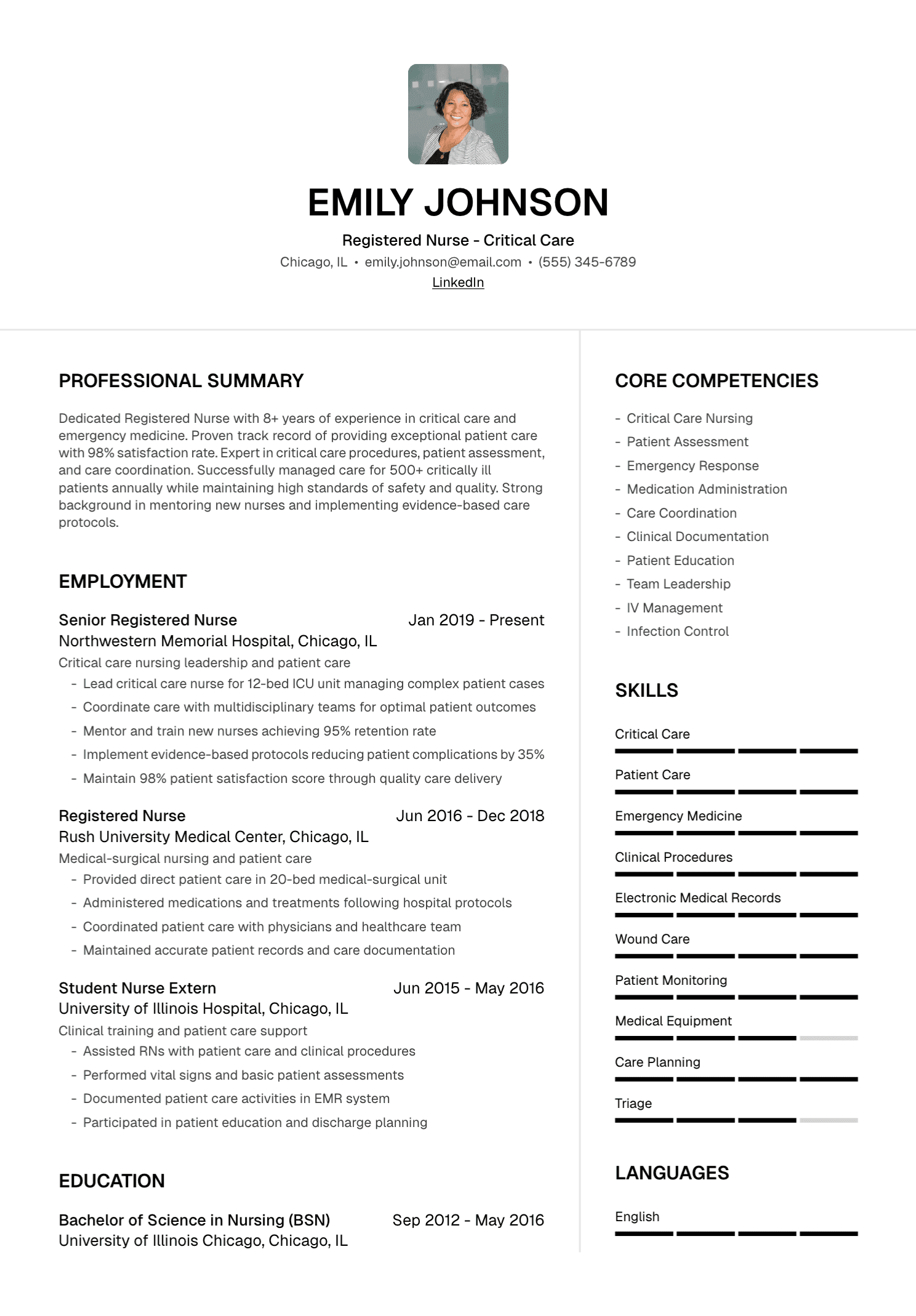
Build a registered nurse resume like this
Use this example as a starting point, then tailor the content, keywords, and layout around the job description you are applying to.
Skills Section for Nurses
The skills section of a nursing resume must effectively showcase your clinical expertise and patient care capabilities. Organize skills by key nursing competencies, from direct patient care to technical proficiencies. For senior positions, emphasize advanced clinical skills and leadership abilities. Include both clinical skills and essential soft skills that demonstrate your ability to provide comprehensive patient care. The key is to present a well-rounded skill set that shows you can handle all aspects of nursing practice, from assessment to intervention. Remember to align your skills with the specific requirements of target positions and healthcare settings. This section should demonstrate your mastery of nursing procedures while showcasing your ability to deliver quality patient care.
Core Clinical Skills
Structure your skills in categories essential for nursing practice:
Patient Care: Assessment, Vital Signs Monitoring, Medication Administration, Wound Care, IV Management
Emergency Care: BLS, ACLS, Trauma Care, Rapid Response, Code Blue Management
Clinical Procedures: Venipuncture, Catheterization, NG Tube Placement, Tracheostomy Care
Documentation: EMR Systems (Epic, Cerner), Care Planning, Clinical Documentation
Patient Safety: Infection Control, Fall Prevention, Medication Safety, Risk Assessment
Specialized Care: Critical Care, Pediatrics, Obstetrics, Oncology, Geriatrics (based on specialty)
Advanced Nursing Competencies
For senior roles, highlight specialized skills and leadership capabilities:
Clinical Leadership: Unit Management, Staff Development, Quality Improvement, Policy Development
Advanced Procedures: Ventilator Management, Central Line Care, Advanced Wound Care
Care Coordination: Interdisciplinary Collaboration, Care Planning, Discharge Planning
Quality Metrics: Patient Outcomes, Safety Indicators, Regulatory Compliance
Education: Staff Training, Patient Education, New Graduate Mentoring
Essential Nursing Soft Skills
Highlight crucial interpersonal and professional skills for nursing success:
Communication: Patient/Family Education, Team Collaboration, Crisis Communication
Critical Thinking: Clinical Decision Making, Problem Solving, Priority Setting
Emotional Intelligence: Compassion, Empathy, Stress Management, Cultural Sensitivity
Time Management: Multiple Patient Care, Task Prioritization, Efficient Documentation
Teamwork: Interdisciplinary Collaboration, Shift Handoff, Team Support
Professional Experience Section
Your professional experience section must tell a compelling story of your nursing journey through concrete achievements and measurable patient care outcomes. Each role should demonstrate progression in clinical expertise, leadership responsibility, and specialized skills. Focus on showcasing successful patient care initiatives, quality improvements, and your ability to work in complex healthcare environments. Include details about unit sizes, patient populations, and key performance metrics achieved. Demonstrate your ability to work across the full spectrum of patient care, from assessment to discharge. For each position, highlight not just what procedures you performed, but how you improved patient outcomes and contributed to unit excellence. Include examples of clinical leadership, interdisciplinary collaboration, and evidence-based practice implementation.
Senior Nurse Experience Example
For senior positions, emphasize clinical leadership, specialized expertise, and unit impact.
ICU Charge Nurse | Metropolitan Medical Center | 2020-Present
Lead nurse for 15-bed intensive care unit in Level I trauma center
- Led implementation of evidence-based protocols reducing ventilator-associated pneumonia rates by 40%
- Managed team of 25 nurses while maintaining 98% staff retention rate
- Developed rapid response protocol reducing code blue incidents by 35%
- Mentored 15 new graduate nurses with 100% successful orientation completion
- Achieved unit CLABSI rates 50% below national average through staff education
Specialties: Critical Care, Trauma, Ventilator Management, Staff Development
Emergency Department Clinical Coordinator | City Hospital | 2018-2020
Coordinated care delivery in 40-bed emergency department
- Reduced average ED wait times from 45 to 28 minutes through process improvement
- Implemented triage optimization program improving patient flow by 30%
- Led department's successful stroke center certification initiative
- Achieved 95% compliance with core measures through staff education
Specialties: Emergency Care, Trauma, Clinical Education, Quality Improvement
Mid-Level Nurse Experience Example
For mid-level positions, focus on clinical expertise and growing unit responsibilities.
Medical-Surgical RN | Community Hospital | 2018-2020
Provided comprehensive care in 30-bed medical-surgical unit
- Maintained zero medication errors while managing 6-patient assignments
- Reduced unit fall rates by 25% through implementation of hourly rounding
- Served as unit wound care champion, reducing pressure ulcer incidents by 40%
- Precepted 8 new graduate nurses with 100% retention rate
- Led unit-based council initiatives improving patient satisfaction scores by 15%
Specialties: Med-Surg, Wound Care, Patient Education
Labor & Delivery RN | Women's Hospital | 2016-2018
Provided care for high-risk obstetric patients
- Successfully managed 300+ deliveries including 75 high-risk cases
- Implemented patient education program reducing C-section rates by 20%
- Achieved 100% compliance with maternal safety protocols
- Recognized for excellence in fetal monitoring and assessment
Specialties: Obstetrics, High-Risk Pregnancy, Fetal Monitoring
Clinical Experience and Achievements
Your clinical experience section should showcase your ability to provide exceptional patient care while demonstrating your impact on healthcare outcomes. Each experience should tell a complete story: the clinical setting, your responsibilities, and measurable improvements in patient care. Focus on experiences that demonstrate your expertise in specific areas of nursing and your ability to implement evidence-based practices. Include both direct patient care achievements and quality improvement initiatives. For each role, detail your contributions to patient outcomes, unit performance, and healthcare team success. This section should demonstrate not just your clinical skills, but how you've improved patient care and unit efficiency.
Clinical Achievement Presentation Guide
Each clinical experience should clearly communicate your role, responsibilities, and impact on patient care.
Intensive Care Unit Excellence
Clinical Setting: 20-bed ICU in Level I Trauma Center Key Responsibilities: Provided critical care to high-acuity patients requiring ventilator and hemodynamic support, coordinated care with multidisciplinary teams including physicians, respiratory therapy, and specialists, and served as charge nurse for unit of 15 staff members
- Reduced ventilator-associated pneumonia rates by 45% through protocol implementation
- Achieved zero central line infections for 12 consecutive months
- Decreased average length of stay by 1.5 days through early mobility program
- Maintained 100% compliance with core measures
Specialties: Critical Care, Ventilator Management, Trauma Care
Emergency Department Impact
Clinical Setting: Level II Trauma Center with 75,000 annual visits Key Responsibilities: Managed care for critical and acute patients in fast-paced environment, led trauma team responses and coordinated emergency interventions, and mentored new graduate nurses in emergency care protocols
- Improved door-to-triage times by 40% through process optimization
- Achieved 98% compliance with stroke protocols
- Implemented bedside reporting process reducing handoff errors by 60%
- Received Unit Excellence Award for outstanding patient care
Specialties: Emergency Care, Trauma Response, Triage Management
Quality Improvement Initiatives
Highlight contributions to improving patient care and unit performance.
Patient Safety: Implemented fall prevention program reducing incidents by 50%
Care Quality: Developed evidence-based protocol improving wound healing times by 30%
Staff Development: Created orientation program achieving 95% new nurse retention
Documentation: Streamlined EMR processes reducing charting time by 25%
Patient Satisfaction: Achieved 98th percentile in patient satisfaction scores
Clinical Leadership and Recognition
Showcase leadership roles and professional recognition in nursing.
Unit Leadership: Charge Nurse role with oversight of 20+ staff members
Committee Work: Chair of Unit-Based Council implementing 10+ quality initiatives
Mentorship: Precepted 15+ new graduate nurses with 100% success rate
Recognition: Recipient of Nursing Excellence Award for Clinical Leadership
Professional Impact: Published in nursing journal on innovative care protocols
Education and Certifications
The education section for a nurse should emphasize both formal nursing education and ongoing professional certifications that demonstrate your clinical expertise. Focus on relevant coursework, clinical rotations, and specialized training. For advanced degrees like MSN, highlight specializations and research that demonstrate expertise in specific areas of nursing. Professional certifications should showcase your commitment to excellence in specific nursing specialties. Include not just certification names but also any significant clinical achievements or improvements implemented using this specialized knowledge. Remember to highlight any academic projects or clinical experiences that demonstrate leadership, research, or exceptional patient care. This section should demonstrate both your strong educational foundation and your commitment to continuing education in nursing practice.
Education Presentation
Present your education with emphasis on relevant clinical rotations and nursing specializations.
Master of Science in Nursing (MSN) | University Medical School | 2018-2020
Specialization: Critical Care Nursing
- GPA: 3.94/4.0
- Led evidence-based practice project reducing ICU infection rates by 40%
- Completed 1,000+ clinical hours in level-1 trauma center
- Conducted research on ventilator-associated pneumonia prevention
- Relevant Coursework: Advanced Pathophysiology, Pharmacology, Clinical Decision Making
Bachelor of Science in Nursing (BSN) | State University | 2014-2018
- Clinical Excellence Award Recipient
- Clinical Rotations: Medical-Surgical, Pediatrics, Obstetrics, Mental Health
- Leadership Role: President, Student Nurses Association
- Research Project: 'Implementation of Bedside Shift Reporting'
- Dean's List: All semesters
Professional Certifications
List certifications that demonstrate specialized nursing expertise and commitment to excellence.
Critical Care Registered Nurse (CCRN) Certification
Advanced Cardiac Life Support (ACLS) Certification
Basic Life Support (BLS) Certification
Trauma Nursing Core Course (TNCC) Certification
Pediatric Advanced Life Support (PALS) Certification
Professional Development
Highlight ongoing learning and engagement in nursing practice.
Active Member of American Association of Critical Care Nurses (AACN)
Regular Presenter at Nursing Education Conferences
Published Research in American Journal of Nursing
Unit-Based Council Chair for Evidence-Based Practice
Mentor in Hospital's New Graduate Nurse Residency Program
Resume Optimization and Formatting
A nursing resume must effectively balance clinical expertise with patient care achievements while ensuring compatibility with both ATS systems and human reviewers. This requires thoughtful organization and clear presentation of your healthcare journey. Use industry-standard section headings and naturally incorporate relevant nursing terminology throughout your resume. The layout should guide readers through your progression as a healthcare professional while keeping critical information easily scannable. Consider your audience - include enough clinical detail to demonstrate expertise while keeping descriptions accessible to HR professionals. Pay special attention to formatting consistency, especially with patient care metrics and clinical achievements. Use a clean, professional font and maintain adequate white space to enhance readability. Remember to include your nursing license number and certifications prominently.
ATS Optimization for Nursing Roles
Ensure your resume passes Applicant Tracking Systems while maintaining readability for hiring managers.
Include key nursing terms naturally (e.g., 'patient care', 'clinical assessment', 'medication administration')
Use standard section headings and clear formatting that won't confuse ATS systems
Include both clinical terms and common healthcare acronyms (e.g., 'Basic Life Support (BLS)', 'Electronic Medical Records (EMR)')
Nursing Resume Best Practices
Format your resume to effectively showcase your clinical expertise and patient care success.
Strong Resume Structure Example
- Summary: Brief overview highlighting specialties and key clinical achievements
- Skills: Organized by clinical procedures, technical skills, and specializations
- Experience: Focus on patient care outcomes and unit improvements
- Clinical Rotations: Highlight specialized experience and patient populations
- Certifications: Emphasize current licenses and clinical certifications
Metrics Presentation Example
- Patient Care: 'Managed 6-patient assignments in high-acuity unit'
- Quality: 'Achieved 100% compliance with core measures'
- Safety: 'Reduced medication errors by 40% through protocol implementation'
- Leadership: 'Precepted 12 new nurses with 100% retention rate'
Common Resume Mistakes
Avoid these common pitfalls in nursing resumes:
Focusing on routine duties instead of patient care achievements
Not demonstrating progression in clinical expertise and responsibility
Missing key metrics (patient outcomes, safety improvements, quality measures)
Underemphasizing critical soft skills like communication and teamwork
Make your experience impossible to miss.
Build an ATS-friendly resume tailored to the job, create a matching cover letter, and be ready to apply in minutes.
4.58/5
49,000+ job seekers
Start for free · No credit card required