Introduction
Grok has a confident personality, and confidence can feel persuasive when you are staring at a tired resume. I wanted to know how that style would hold up under the discipline of resume writing, where every polished phrase still needs a factual foundation.
The question for this test was simple: could Grok produce a focused, readable draft from the candidate's real experience?
This hands-on comparison uses the same source material as ChatGPT vs. Claude, DeepSeek vs. ChatGPT, and Gemini vs. ChatGPT. The repeated setup makes each model's editorial habits easier to recognize.
The Test: Same Resume, Same Job, Every AI
We're using the identical resume section and job description from every previous comparison in this series. This means you can directly compare Grok's output against Claude, DeepSeek, Gemini, and ChatGPT — all on the same task.
Here's the experience entry both models were asked to optimize:
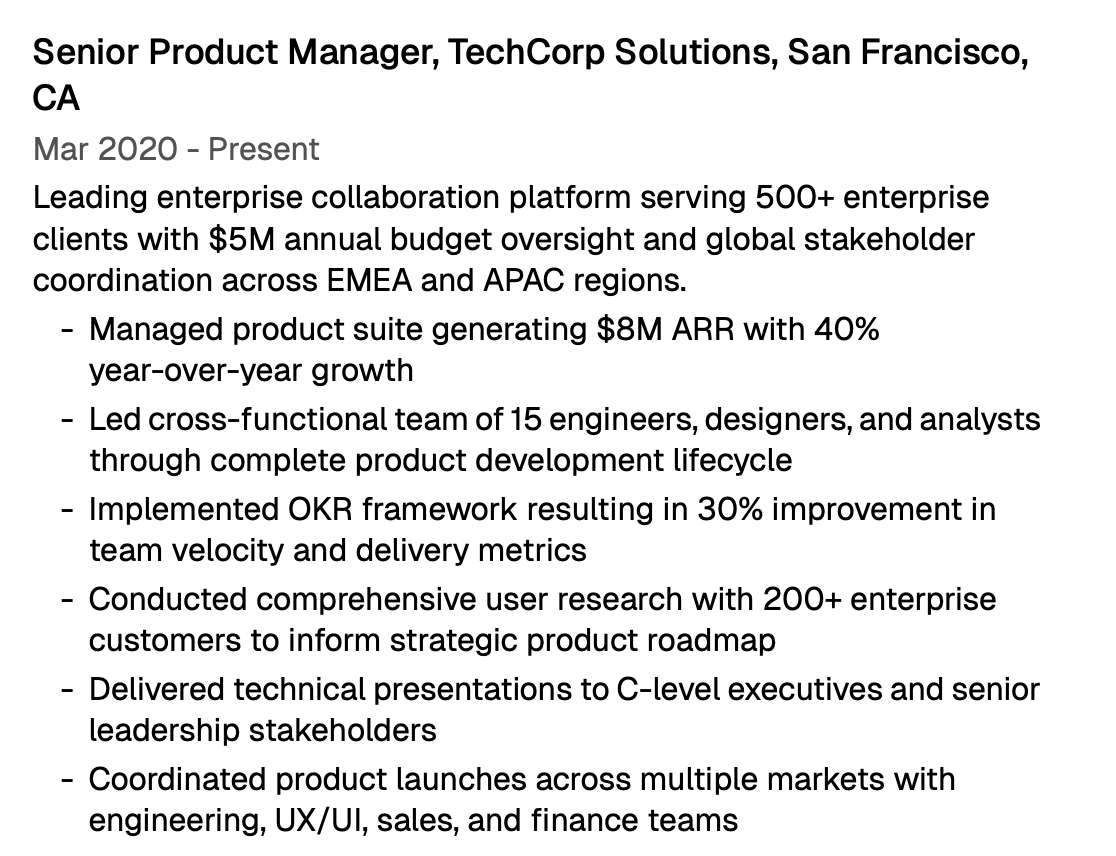
The target role is a Program Manager at Google on the Supply Chain Resiliency team. The job description emphasizes cross-functional program leadership, supply chain experience, process standardization, risk mitigation, and data-driven decision-making.
Both models received the same prompt: rewrite the section to match the job description more closely while keeping it truthful to the original experience.
I judged the results on fidelity, relevance, clarity, and the amount of editing required before submission. The scores reflect the two drafts shown here; a second run may produce different wording.
Grok Expert 4.2
Grok delivered a single rewrite with a confident explanation of its strategy. Here's the output:
Senior Product Manager, TechCorp Solutions, San Francisco, CA Mar 2020 – Present
- Provided direct project leadership and subject matter knowledge to drive the development and launch of an enterprise SaaS platform serving 500+ B2B clients in the technology industry while managing a $5M annual budget
- Structured and executed cross-functional strategic initiatives by managing a team of 15 engineers, designers, and product analysts to deliver operational plans and results
- Defined business requirements in conjunction with functional owners and SMEs by conducting user research with 200+ enterprise customers, gathering and synthesizing data to identify pain points, perform analyses, and develop compelling recommendations that drove product improvements
- Built organizational support by presenting quarterly product strategy and recommendations to C-level executives and board members
- Drove speed, quality, and simplification by implementing an OKR framework that improved team velocity by 30%, eliminating rework loops through standardization and best practices
- Structured and executed cross-functional strategic initiatives to launch the platform in 3 new international markets (EMEA, APAC), coordinating with local teams to minimize process variability and ensure successful execution
- Delivered measurable strategic outcomes by growing product revenue from $2M to $8M ARR (300% growth) over 3 years through data-driven optimization and capability enhancements
Grok's approach is immediately clear: it places a large share of the employer's wording inside the bullets. "Provided direct project leadership and subject matter knowledge," "structured and executed cross-functional strategic initiatives," "defined business requirements in conjunction with functional owners and SMEs," and "eliminating rework loops through standardization" all closely follow the posting.
Keeping the official job title was a sound choice. The factual review becomes less comfortable once we reach the bullets. The source material needs to support subject-matter knowledge, operational plans, rework elimination, standardization, best practices, process variability, and data-driven capability enhancements. Grok's confident explanation cannot verify those details.
The execution also has significant readability problems.
The phrase "structured and executed cross-functional strategic initiatives" appears in both bullet 2 and bullet 6. That repetition makes the section feel assembled from the posting.
Bullet 3 carries five separate phrases from the job description and becomes difficult to scan. I would split the underlying ideas or keep the single achievement that best proves fit for this role.
Several bullets feel driven by the employer's vocabulary, with the candidate's metrics attached afterward. The candidate's own work should control the sentence.
Grok also encouraged direct copy-and-paste use. I strongly disagree with that recommendation. Every AI-written resume needs a line-by-line factual review.
Overall score: 2.75/5 — Strong language coverage, weakened by repetition, dense writing, and unsupported inferences.
ChatGPT Thinking 5.4
ChatGPT again delivered two versions with practical coaching. Here's the stronger variant:
Senior Product Manager, TechCorp Solutions — San Francisco, CA Mar 2020 – Present
- Led strategic cross-functional programs for an enterprise technology platform serving 500+ B2B clients, with accountability for a $5M annual budget, roadmap execution, and operational delivery
- Managed a 15-member cross-functional team across engineering, design, and analytics to deliver new capabilities, align stakeholders, and improve execution against business priorities
- Conducted structured research with 200+ enterprise customers to gather data, identify operational pain points, and inform recommendations that improved product and process outcomes
- Defined priorities and communicated quarterly strategy, risks, and execution plans to executive leadership and board members, enabling faster decision-making and stronger organizational alignment
- Standardized planning and execution through implementation of an OKR framework, improving team velocity by 30% and reducing rework across initiatives
- Coordinated cross-regional launches across EMEA and APAC, partnering with local teams to support operational readiness, regional requirements, and streamlined execution
- Drove revenue growth from $2M to $8M ARR in 3 years through disciplined program execution, customer-focused improvements, and scalable operational processes
ChatGPT's draft is easier to read. Each bullet carries one main idea, and the section communicates cross-functional leadership, research, planning, and international coordination clearly.
The job-description language also reads more naturally. Phrases such as "strategic cross-functional programs," "operational pain points," "standardized planning and execution," "reducing rework," and "operational readiness" fit the sentence around them.
ChatGPT was transparent about the candidate's positioning. It identified the missing direct experience in supply chain, commodity management, trade compliance, and import/export work. That gap analysis gives the candidate a realistic way to prepare for questions.
The suggested skills line still needs verification. Risk mitigation, process standardization, and spreadsheet analysis belong on the resume only when the candidate has used them.
ChatGPT's output also adds execution plans, reduced rework, operational readiness, and scalable operational processes. I would confirm each phrase before submission.
Overall score: 3.75/5 — Clear, professional, and useful, with several inferences that need confirmation.
The Verdict: ChatGPT Wins on What Actually Matters
A resume needs clear evidence, relevant language, and a readable structure. ChatGPT handled that combination more successfully in this test.
Grok Expert 4.2 achieves high raw phrase coverage. Repetition, dense bullets, and unsupported details weaken the draft.
ChatGPT Thinking 5.4 produces cleaner resume content and provides stronger gap analysis. The draft still requires factual review.
My verdict: ChatGPT wins this round. I would use its structure, verify every expanded claim, and simplify any phrase I would never say naturally in an interview.
Pricing and Accessibility

Access, model availability, usage limits, and prices change frequently for both services. Check the official Grok and ChatGPT plan pages before paying for a subscription. Existing access through X may influence the practical choice for some users.
Specialized Resume AI Platforms: Why Purpose-Built Wins
General-purpose chat tools leave the full workflow with you: prompt design, factual review, version comparison, and formatting.
UseResume keeps your source resume, target job description, tailored draft, and document formatting in one workflow. Review each suggestion carefully and keep the language grounded in your real experience.
Making the Right Choice
If you're choosing between Grok and ChatGPT for resume writing:
- Use ChatGPT if you want a readable first draft and candid coaching about gaps in your experience.
- Use Grok if you want to study the employer's terminology and are prepared to rewrite dense passages and verify every inference.
- Use a specialized tool if you want the tailoring and formatting steps in one workflow.
Ready to Get Started?
Create your account and build a tailored resume you can review and defend with confidence.
Want to see the full picture? Read all our AI resume comparisons: ChatGPT vs Claude · DeepSeek vs ChatGPT · Gemini vs ChatGPT