Marketers Feel Pressure to Market Themselves
That pressure can produce a resume full of campaigns that “transformed” the business, revenue attributed to one channel, and percentages with no baseline. Experienced marketing leaders usually know that the real story is more complicated.
A campaign depends on product, price, sales, seasonality, creative, distribution, data quality, and market conditions. Your resume should still show impact. It should also show that you understand measurement and attribution well enough to describe your contribution honestly.
The strongest marketing resumes are specific about audience, objective, decision, channel mix, ownership, budget, team, and verified outcome.
Define Your Marketing Lane
Marketing manager titles cover demand generation, lifecycle, brand, product marketing, content, performance, communications, events, partnerships, and regional or integrated marketing. Many roles combine several.
Read the target posting and identify its center. A B2B demand-generation role may care about pipeline, sales alignment, buying groups, and marketing operations. A consumer growth role may emphasize acquisition, activation, retention, experimentation, and unit economics. Brand roles may prioritize positioning, research, creative development, and brand health.
Your profile and first-page achievements should establish the relevant lane. A broad “360-degree marketer” label often hides the very expertise the employer wants to see.
Build a Campaign Evidence File
For every important campaign or program, record the business objective, target audience, insight, your decision, your contribution, collaborators, channels, budget, timeframe, deliverables, and outcome.
Add the metric source and definition. “Qualified lead” can mean one thing in marketing automation and another in sales. “Revenue influenced” differs from booked revenue. “Engagement” may refer to clicks, reactions, time, or a composite score.
Keep evidence from dashboards, campaign reports, briefs, and reviews where company policy allows. Never remove confidential company material. Personal notes can capture nonconfidential facts and metric definitions.
Show Strategy Through Decisions
Calling yourself strategic adds little. Describe the decision.
You may have changed audience segmentation after analyzing conversion, shifted budget toward a stronger channel, repositioned a product around a customer problem, designed a nurture path for a long sales cycle, or stopped a campaign after weak early evidence.
A resume bullet can hold the clearest part:
Reallocated paid-search budget toward three high-intent segments after a six-week conversion review, improving verified cost per qualified lead from [baseline] to [result].
Fill the brackets only with numbers your reporting supports.
Write From Source Notes
Imagine these hypothetical notes:
Launched a webinar series for finance leaders. I chose topics from sales-call notes, managed the agency and speakers, and built the email nurture. We ran four webinars. 620 people registered, 280 attended, and sales accepted 34 leads under our agreed definition. Pipeline attribution was unavailable.
A credible bullet could read:
Created a four-part webinar program for finance leaders from sales-call insights, coordinating speakers, agency delivery, and email nurture to generate 620 registrations, 280 attendees, and 34 sales-accepted leads.
The line uses the outcomes that exist. It leaves pipeline and revenue alone because the source offers no attribution.
Use Metrics With Their Meaning Intact
Choose measures that fit the work:
| Marketing area | Useful measures when verified |
|---|---|
| Demand generation | Qualified leads, accepted leads, pipeline, conversion by stage, cost per lead |
| Performance marketing | Spend, acquisition cost, return on ad spend, conversion, incremental lift |
| Lifecycle | Activation, repeat use, retention, churn, email conversion, time to value |
| Content | Qualified traffic, assisted conversion, subscribers, content-influenced opportunities |
| Product marketing | Adoption, win rate, launch readiness, sales enablement use, message testing |
| Brand | Awareness, consideration, preference, share of search, study-based lift |
State the baseline, period, or audience when it changes the interpretation. A 20% increase across one week means something different from a sustained annual result.
Avoid combining incompatible measures into one impressive sentence. A campaign may raise traffic while qualified conversion falls. Good marketers can discuss that tension.
Be Honest About Attribution
Marketing contribution language deserves precision. “Generated” suggests a closer causal link than “influenced” or “supported.” Use the terminology your company defined and your reporting can defend.
For a cross-functional launch, you might write:
Led go-to-market planning for a new reporting module with product, sales, and customer success, delivering positioning, enablement, launch content, and a regional rollout plan that supported [verified adoption or commercial result].
The outcome belongs only when the measurement exists. The deliverables already show substantial work.
Show Budget and Resource Judgment
Budget size gives useful scope when sharing it is allowed. Explain what you controlled: annual media spend, campaign budget, agency retainer, event portfolio, or regional allocation.
Saving money is one kind of result. Better allocation is another. A candidate may have moved spend after channel analysis, negotiated vendor terms, or delivered the same program with a tighter budget.
Keep currency and period clear. “Managed a $1.2M annual paid-media budget” is easier to understand than “managed seven-figure spend.”
Make Leadership Visible
State whether you managed employees, agencies, freelancers, or a matrix team. Include number, function, and geography when relevant.
Marketing leadership also appears in how you set priorities, gave creative feedback, aligned sales and product, built reporting, and developed team members. A list of direct reports alone gives limited insight.
A clear bullet might say:
Managed a five-person content and lifecycle team, introducing quarterly planning and individual development reviews across two regional markets.
Add a result when verified. Avoid manufacturing a productivity percentage to complete the sentence.
Name Tools Through Applied Work
A concise skills section can list analytics, CRM, marketing automation, advertising, content, research, and project-management platforms relevant to the role.
Experience bullets should show the important tools in context. “Built lifecycle segments and reporting in [platform]” tells the reader more than a long software inventory.
Keep proficiency honest. Administering a system, building workflows inside it, and viewing reports require different depth.
Structure the Resume
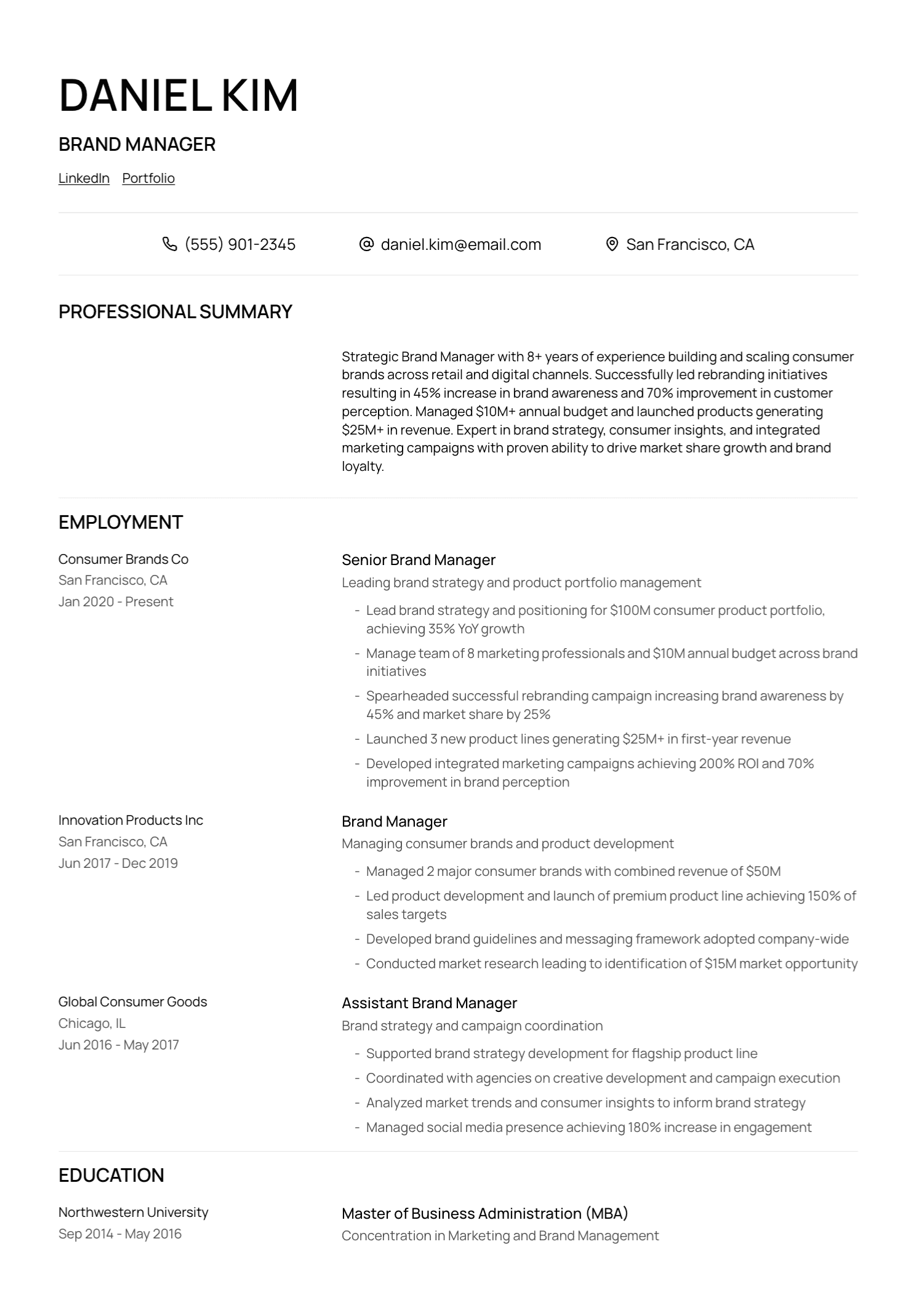
Start with a short profile that identifies your marketing area, market, and strongest relevant scope. A B2B SaaS marketer may mention enterprise demand generation, lifecycle, sales alignment, and regional ownership. A consumer marketer may lead with acquisition channels, experimentation, retention, and category experience.
Follow with focused skills when tools or channels matter. Use reverse-chronological experience and put the most relevant campaigns first within each role. Education, certifications, speaking, awards, or a portfolio can follow.
Two pages may serve an experienced manager well. Give important programs enough context and remove repetitive channel lists.
A Hypothetical Profile
B2B marketing manager experienced in demand generation, webinar and content programs, lifecycle nurture, and sales alignment for financial software. Managed agency partners and regional campaigns across the UK and DACH markets, with reporting focused on sales-accepted leads and stage conversion.
Each detail should appear as evidence below. Replace the domain, regions, programs, and measures with your own facts.
Tailor for B2B, Consumer, and Brand Roles
A B2B resume should make the audience, sales process, product complexity, and funnel definitions clear. Mention buying groups, account strategy, enablement, pipeline, and long-cycle nurture where they belong to your work.
A consumer resume may give more attention to scale, channel economics, creative testing, product behavior, lifecycle, and repeat purchase. Clarify whether results came from paid, organic, in-product, retail, or integrated activity.
A brand resume should show research, positioning, creative direction, agency leadership, campaign delivery, and how brand outcomes were measured. Awards can support the story, while business and audience evidence keeps it grounded.
Build a Portfolio With Context
A marketing portfolio can include campaign briefs, messaging, creative, launch plans, research, dashboards, or sanitized case studies. Explain the objective, constraints, your contribution, team, and result.
Remove confidential data and secure permission where needed. Generalize metrics or visuals while keeping the case useful. Label speculative or reconstructed work clearly.
The portfolio should deepen the evidence on the resume. A gallery of attractive assets says little about the strategy or the candidate's role.
Moving Into Management
A first-time manager can show leadership before the title changes. Mentoring, agency direction, project ownership, budget responsibility, planning, stakeholder alignment, and feedback may all provide relevant evidence.
Keep formal people-management claims accurate. Leading a campaign team differs from managing employees and conducting performance reviews.
Use the profile to establish readiness through evidence. The experience section should carry the proof.
Use AI With Measurement Boundaries
AI can turn rough campaign notes into concise bullets. It can also invent revenue, overstate attribution, and assign a team result to the marketing manager.
Try this prompt:
Draft marketing-manager resume bullets using only these source notes. Preserve the audience, channel, budget, timeframe, metric definition, baseline, result, attribution method, and my level of ownership. Distinguish generated, influenced, and supported outcomes. Use brackets for missing evidence.
Check every result against the original report. A polished claim can still be analytically wrong.
Where UseResume Fits
UseResume lets you upload or create a resume, add a marketing job description, generate a tailored draft, edit the content, choose a template, and export a PDF. You can also create a cover letter from the same application material.
Review generated campaign language carefully. Keep ownership fair, attribution clear, and metrics traceable.
Let the Resume Show How You Think
Marketing leadership is creative, analytical, commercial, and deeply collaborative. A strong resume never needs to pretend that one person created every outcome.
Show the decisions you made, the work you led, the people you aligned, and the results your reporting can support. That level of honesty reads as senior judgment.
Create your account and build a marketing resume around credible evidence.
Continue with our guides to technical and computer skills and writing strong achievement bullets.