Your Resume Needs More Than a Stack of Technologies
Software engineers often have plenty to say about the system and very little space to say it. The first draft becomes a dense inventory of languages, frameworks, clouds, databases, and every tool touched since university. Then the work itself disappears.
A hiring team needs a clearer picture. What did you build or improve? How complex was the environment? What decisions did you own? Which colleagues depended on your work? What changed after you shipped it?
Your technical skills still matter. They become persuasive when the experience section shows you using them with judgment.
Choose the Role Before You Edit
“Software engineer” covers very different jobs. A frontend product engineer, backend platform engineer, mobile developer, site reliability engineer, embedded engineer, and engineering manager each need a different emphasis.
Read the posting closely and identify the central work. Look beyond the longest technology list. A backend role may care most about reliable services and data consistency. A product engineering role may value experimentation and close collaboration with design. A platform role may focus on developer experience, infrastructure, observability, and operational load.
Seniority also changes the evidence. An early-career resume can lean on internships, academic work, open-source contributions, and well-explained personal projects. A senior resume should make scope, architectural judgment, ownership, influence, and trade-offs visible.
Give the Page a Clear Technical Structure
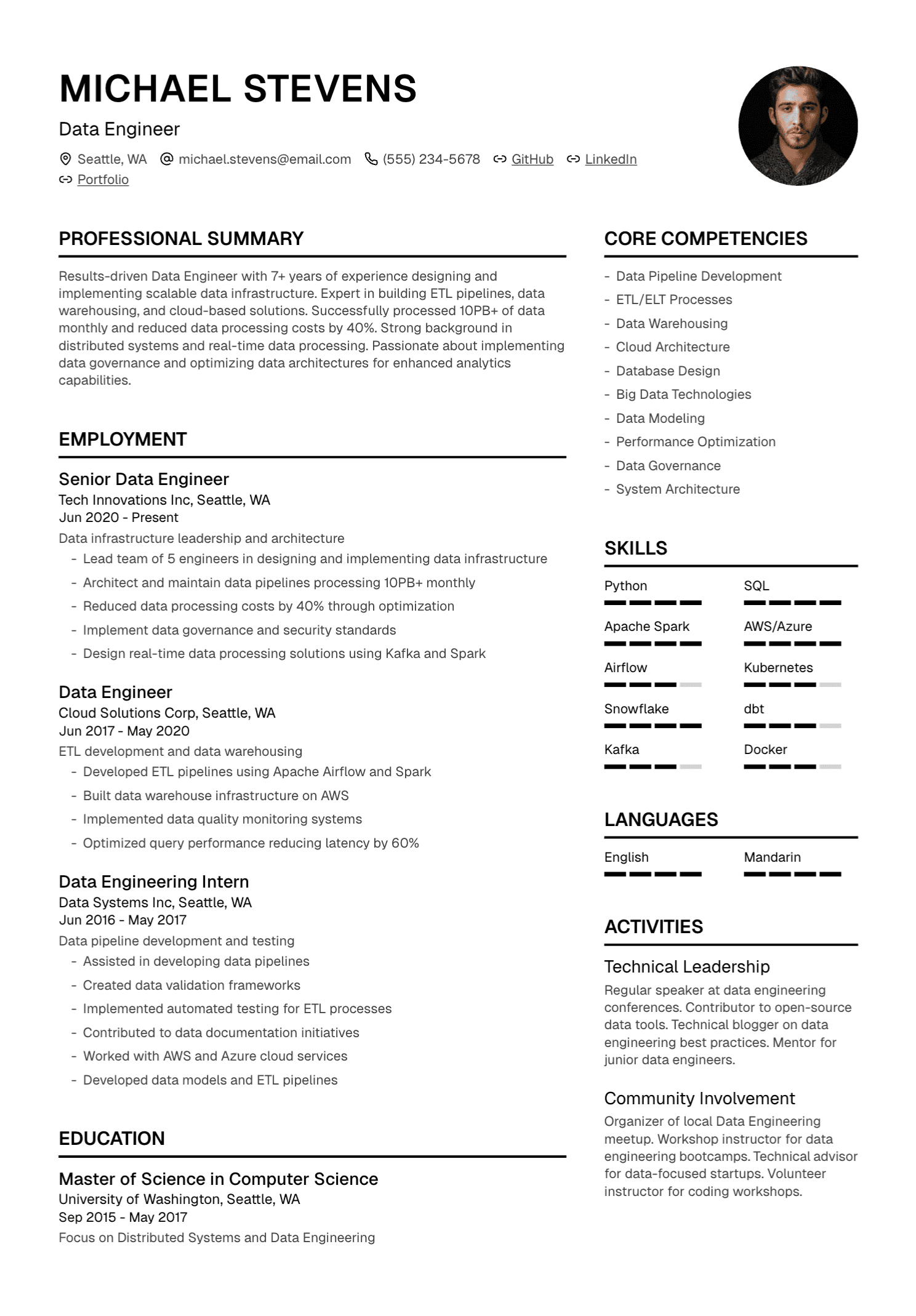
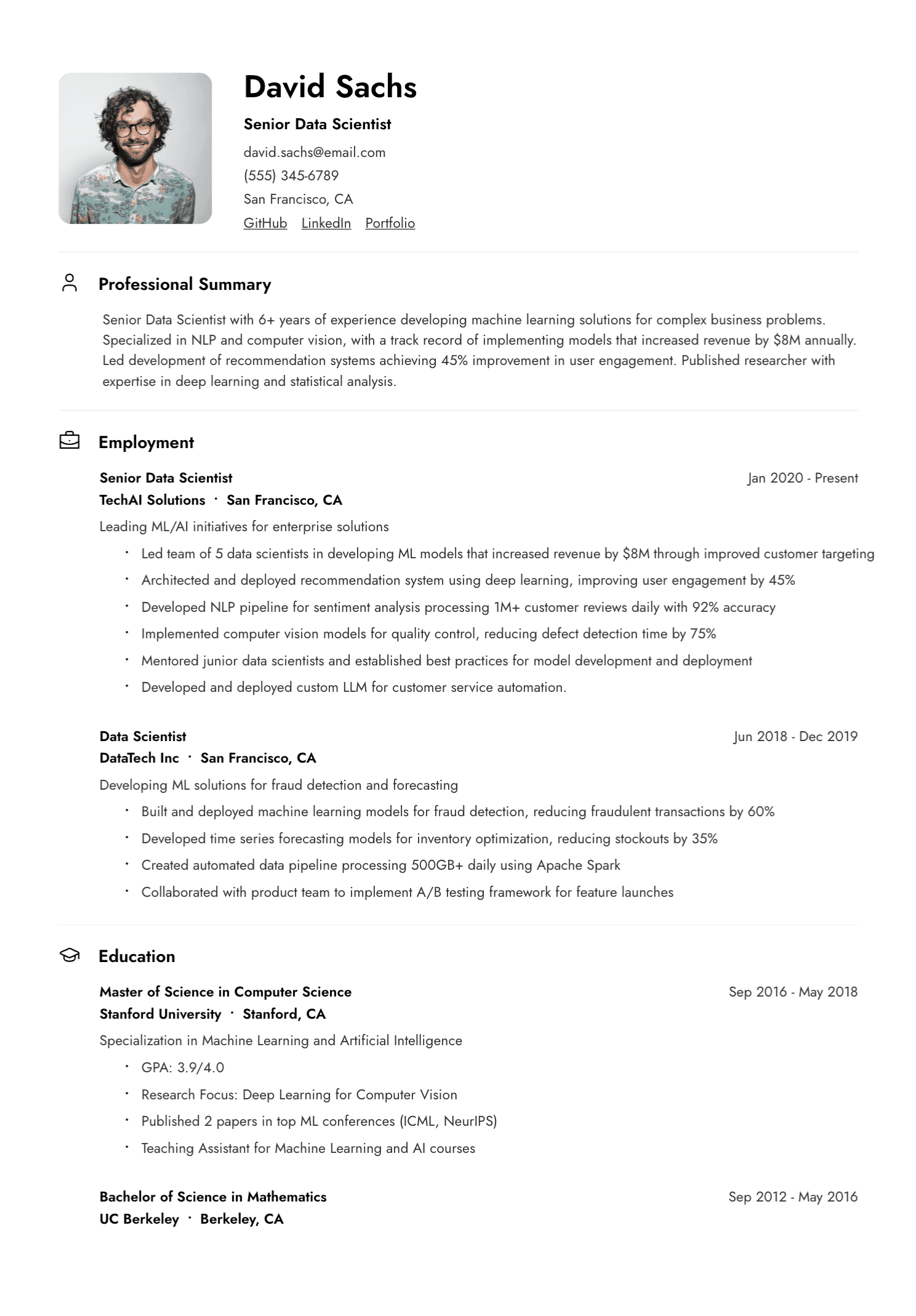
For most engineers, a practical order is contact details, an optional summary, technical skills, professional experience, selected projects, and education. Certifications or publications can earn their own section when they matter to the role.
Put GitHub, a portfolio, a personal site, or a technical blog in the header only when the link helps your candidacy. Test every link in a private browser window. A dormant profile full of unfinished tutorial repositories may add little, while one documented project can add real depth.
Your summary is optional. Use it when it quickly explains your direction, domain, or level:
Backend engineer with seven years of experience building payment and billing services in Java and Kotlin. Recent work has focused on service reliability, event-driven architecture, and developer tooling for teams operating regulated systems.
Every element in that summary should be supported elsewhere on the page.
Build a Selective Skills Section
Group technologies by function so the reader can scan them quickly. The categories should fit your work. A backend engineer might use languages, frameworks, data, cloud and infrastructure, and testing. A frontend engineer may lead with languages, UI frameworks, state and data, testing, accessibility, and build tooling.
A concise section could look like this:
Languages: Java, Kotlin, SQL, Python; Data: PostgreSQL, Redis, Kafka; Infrastructure: AWS, Docker, Kubernetes, Terraform; Testing and observability: JUnit, Testcontainers, Grafana, OpenTelemetry
Include technologies you can discuss with confidence. If you used a framework for one small tutorial several years ago, it probably belongs in your learning notes and can leave the main resume. Keep product names and capitalization accurate.
Proficiency labels such as “expert” and “advanced” vary widely. Experience bullets, projects, current certifications, and years of recent use usually communicate depth with more precision.
Write Experience That a Technical Interviewer Can Explore
Each strong bullet gives the interviewer a useful thread to pull. It may describe a feature, service, migration, incident, developer tool, experiment, or architectural decision. Include the relevant technology when it helps explain the method. Then show scope or outcome with evidence you can defend.
A rigid writing formula is unnecessary. A natural sentence often includes four elements: the problem, your contribution, the technical approach, and the result. Two or three of those may be enough when the context is clear.
Here is a hypothetical rewrite based on explicit source notes.
Source notes: Checkout API had a p95 latency of 1.8 seconds; profiled database calls; added two indexes and changed one query; p95 reached 620 milliseconds in the following release; candidate wrote and deployed the changes.
Reduced checkout API p95 latency from 1.8 seconds to 620 milliseconds by profiling database calls, adding two indexes, and rewriting a high-cost query.
The metric, method, and ownership all come from the notes. No extra claim is needed.
Here is a second hypothetical example where the value is operational.
Source notes: Candidate maintained an internal deployment tool used by 14 engineers; added validation for missing environment variables; related deployment failures fell from 11 in May to 3 in June.
Added environment-variable validation to an internal deployment tool used by 14 engineers, reducing related deployment failures from 11 in May to 3 in June.
The exact month-to-month comparison prevents the result from sounding broader than the evidence.
Use Metrics You Can Explain
Engineering resumes are full of suspiciously perfect percentages. You can write an excellent resume without converting every contribution into revenue or a dramatic efficiency gain.
Useful measures include latency, availability, error rate, throughput, build time, deployment frequency, incident volume, support tickets, test duration, cloud cost, adoption, migration scope, data volume, user scale, and team reach. State the measurement window when it affects interpretation.
When a precise outcome was never recorded, describe scope and significance. You might explain that you migrated twelve services, supported an on-call rotation for a customer-facing platform, removed a manual release step, or wrote the runbook used during handoffs. Concrete scope is valuable evidence.
Keep attribution fair. A performance improvement delivered by a six-person team should sound like a team contribution. Verbs such as “co-developed,” “led,” “owned,” “implemented,” and “contributed to” communicate different levels of responsibility. Choose the one you would use with your former colleagues in the room.
Add Enough Context for People Outside Your Company
Internal project names and private acronyms carry little meaning to a new reader. Translate them into the product, system, customer, or operational context.
“Worked on Project Falcon” leaves the reader guessing. “Developed account-recovery workflows for the company's B2B identity platform” gives her somewhere to begin.
You can usually reveal the type of system, scale, method, and outcome without sharing confidential architecture or customer data. Follow employment agreements, security rules, and professional obligations. Round or generalize sensitive figures only when that treatment remains truthful, and explain them carefully during interviews.
Present Projects as Engineering Work
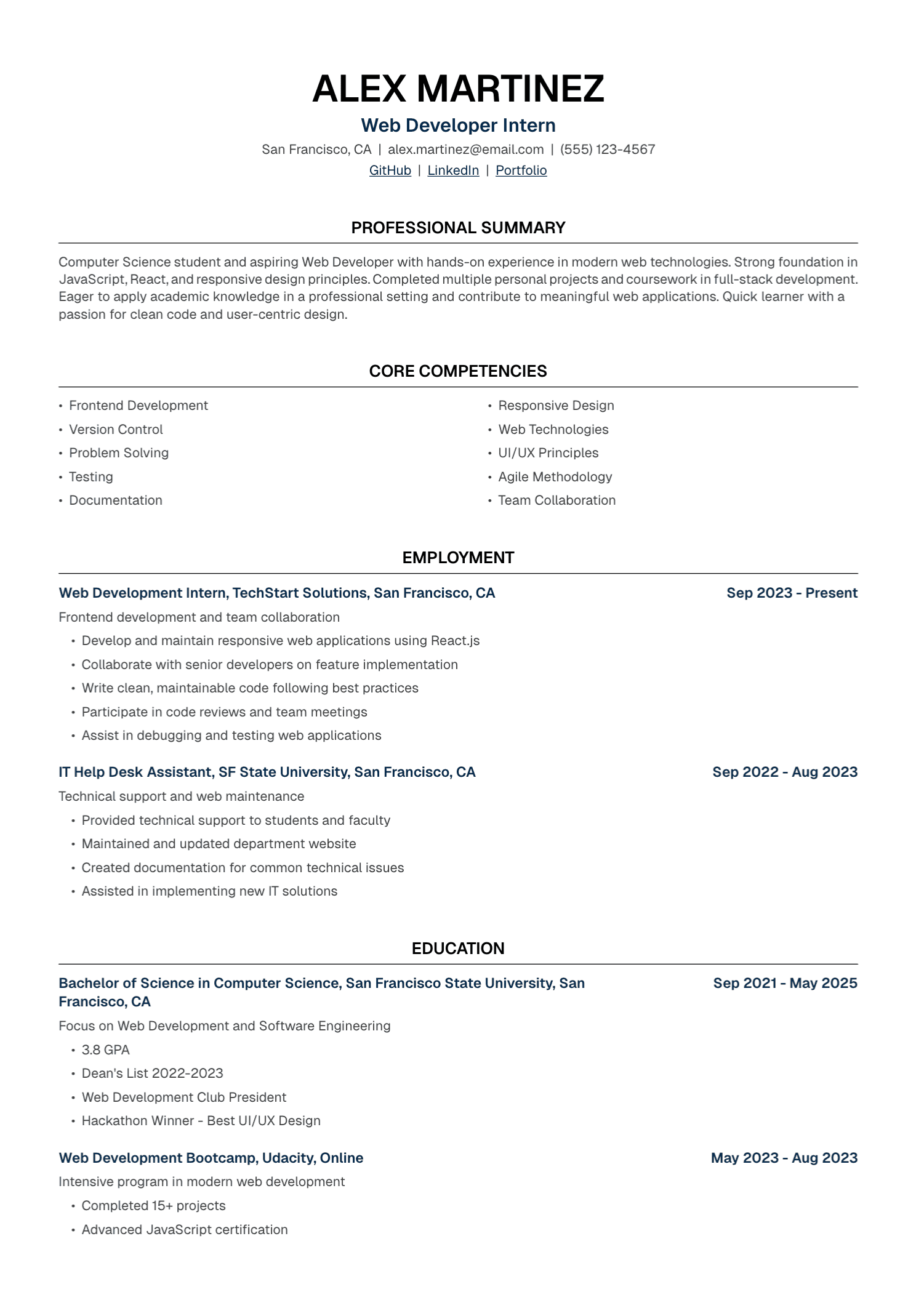
Projects are especially useful for students, career changers, engineers returning after a break, and candidates moving into a new specialty. Choose a few that show the skills the target role requires.
For each project, explain what it does, your contribution, the principal technologies, and one meaningful engineering decision. Add a repository or live demonstration when it is safe, working, and easy to understand.
A project description might cover an accessibility decision, testing strategy, deployment process, data model, performance constraint, security measure, or trade-off you made. These choices reveal more than a long feature list.
Tutorial work can still represent learning, though it should be labeled honestly. Extend it, document what you changed, and explain the part you understand deeply enough to discuss.
Make GitHub Welcoming to a Reviewer
A recruiter may never open your GitHub profile. A technical interviewer might. Curate the first impression for that second reader.
Pin relevant repositories and write a README that explains the purpose, setup, architecture, current limitations, and important decisions. Include tests where they make sense. Remove exposed credentials and inspect commit history for secrets before sharing the link.
Contribution graphs deserve little anxiety. Professional code is often private, and healthy engineering careers leave room for life away from a laptop. The quality and relevance of the work you choose to show matter far more than a continuous wall of green squares.
Tailor for Different Engineering Paths
A frontend resume should show the user-facing problem as well as the framework. Accessibility, performance, design-system work, experimentation, browser behavior, and collaboration with design can all add substance.
A backend resume may emphasize service boundaries, data models, reliability, security, performance, integrations, and operational ownership. Name architecture patterns when you truly used them and can explain the trade-offs.
Platform, cloud, DevOps, and site reliability roles need evidence of the systems other engineers relied on. Show automation, observability, incident response, capacity, infrastructure governance, cost work, or developer experience through concrete changes.
Data and machine-learning roles should distinguish analysis, data engineering, model development, evaluation, deployment, and monitoring. State your own contribution clearly when researchers, analysts, platform engineers, and product teams shared the work.
For engineering leadership, code may occupy less space. Team scope, hiring, coaching, delivery systems, architectural decisions, stakeholder work, and organizational outcomes become more important. Preserve enough technical context to show the environment you led.
Help Resume Software Read the Document
Applicant tracking systems vary. Many can parse resumes, store candidate information, and support recruiter searches. None of this creates a universal score that guarantees an interview.
Use familiar headings such as “Experience,” “Technical Skills,” “Projects,” and “Education.” Keep dates and employer names easy to identify. Avoid placing essential information only inside images, icons, or decorative charts.
Use terminology from the posting where it accurately describes your background. If the employer requests PostgreSQL and your experience is solely MySQL, keep those databases distinct. Adjacent experience may still be relevant, and honesty makes the interview far easier.
Follow the requested file format. A well-exported PDF often preserves layout, while some portals specifically request DOCX or collect information through form fields. Open the final file and make sure the text is selectable and every page renders cleanly.
Read our ATS guide for a deeper explanation of parsing and recruiter search.
Tailor Without Rewriting Your Career Every Time
Keep a comprehensive source resume or achievement document. For each application, choose the experiences, bullets, projects, and skills that best match the role. Reorder where useful and adjust the summary if you use one.
Five careful changes can be more effective than rewriting every line. Bring the relevant specialty forward, mirror accurate terminology, select the strongest evidence, remove distracting older tools, and check the file once more.
Save the tailored version with the posting and your notes. This gives you a reliable record before the interview, especially when several applications are moving at once.
Use AI as an Editor With Source Material
AI can help compare a job description with your resume and tighten technical writing. It can also invent architecture, scale, metrics, ownership, tools, and business outcomes with complete confidence.
Set a narrow task:
Compare this software-engineer job description with my resume. Identify the most relevant experience using exact quotations from my source resume. Rewrite up to five bullets using only supported facts. Preserve technologies, metrics, dates, team sizes, and ownership precisely. Place any missing detail in brackets for me to complete.
Review the technical meaning as carefully as the grammar. “Improved reliability,” “designed the architecture,” and “led the migration” are substantial claims. Each one needs evidence.
UseResume lets you upload or create a resume, add a job description, generate a tailored version, edit rewritten bullets, choose a template, and export a PDF. Keep control of the final technical language and remove every unsupported addition.
The Final Review
Before submitting, ask whether another engineer could understand the systems you worked on and your contribution to them. Check that important technologies appear in context, metrics have a source, team achievements have fair attribution, and project links work.
Then read for ordinary human clarity. A resume can be technically impressive and still feel exhausting. Short sentences, selective detail, and calm confidence will carry your work further.
Your best material is usually already in your career. The job is to uncover it, name it precisely, and give the reader a reason to ask the next question.
Create your UseResume account and build a focused software-engineering resume.
Continue with our guides to technical skills for a resume and adding a portfolio.