
Detailed Guide on How to Write a Data Scientist Resume
Review a data scientist resume example, then build a targeted version with AI or check your current resume score.
Professional Summary for Data Scientists
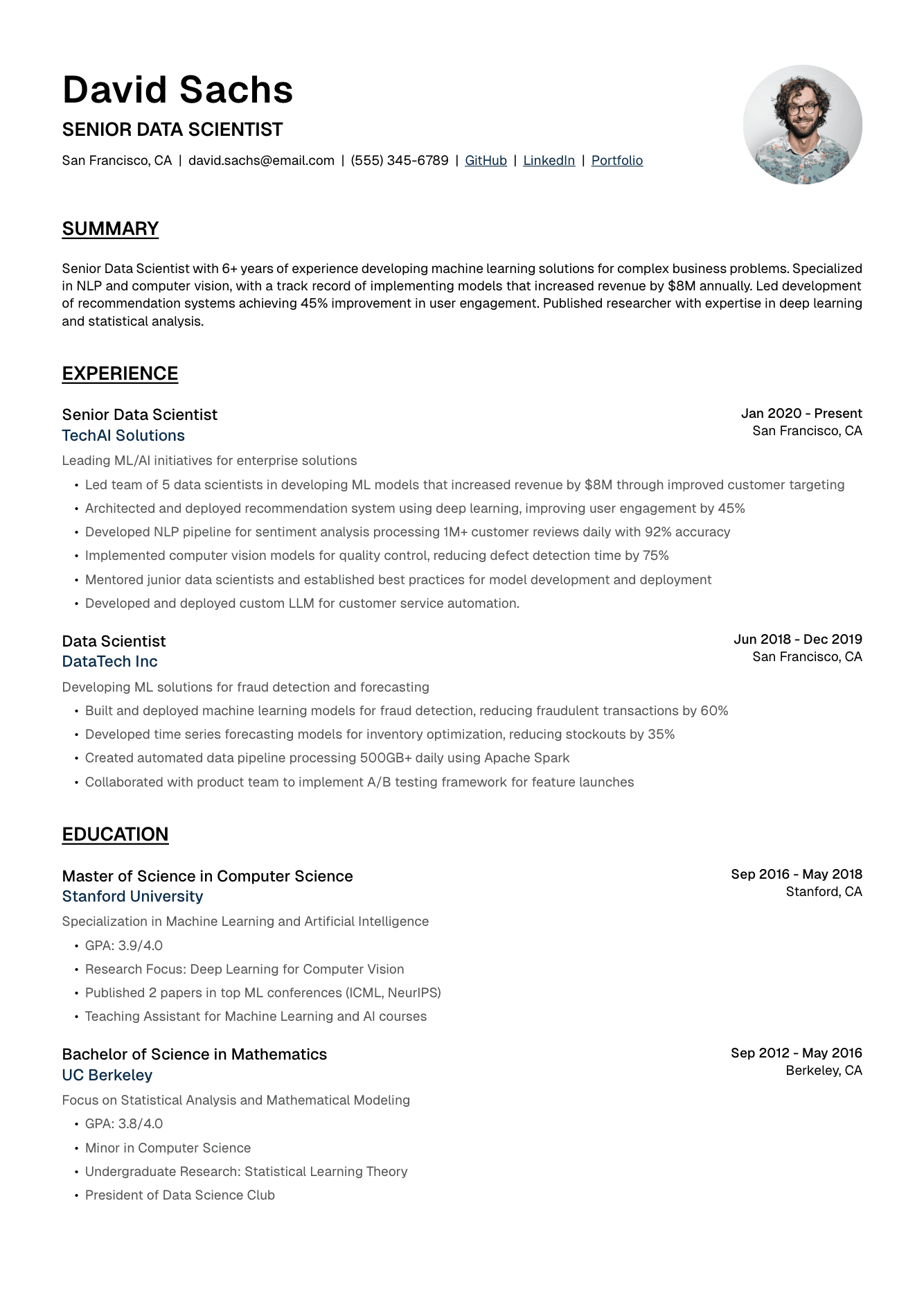
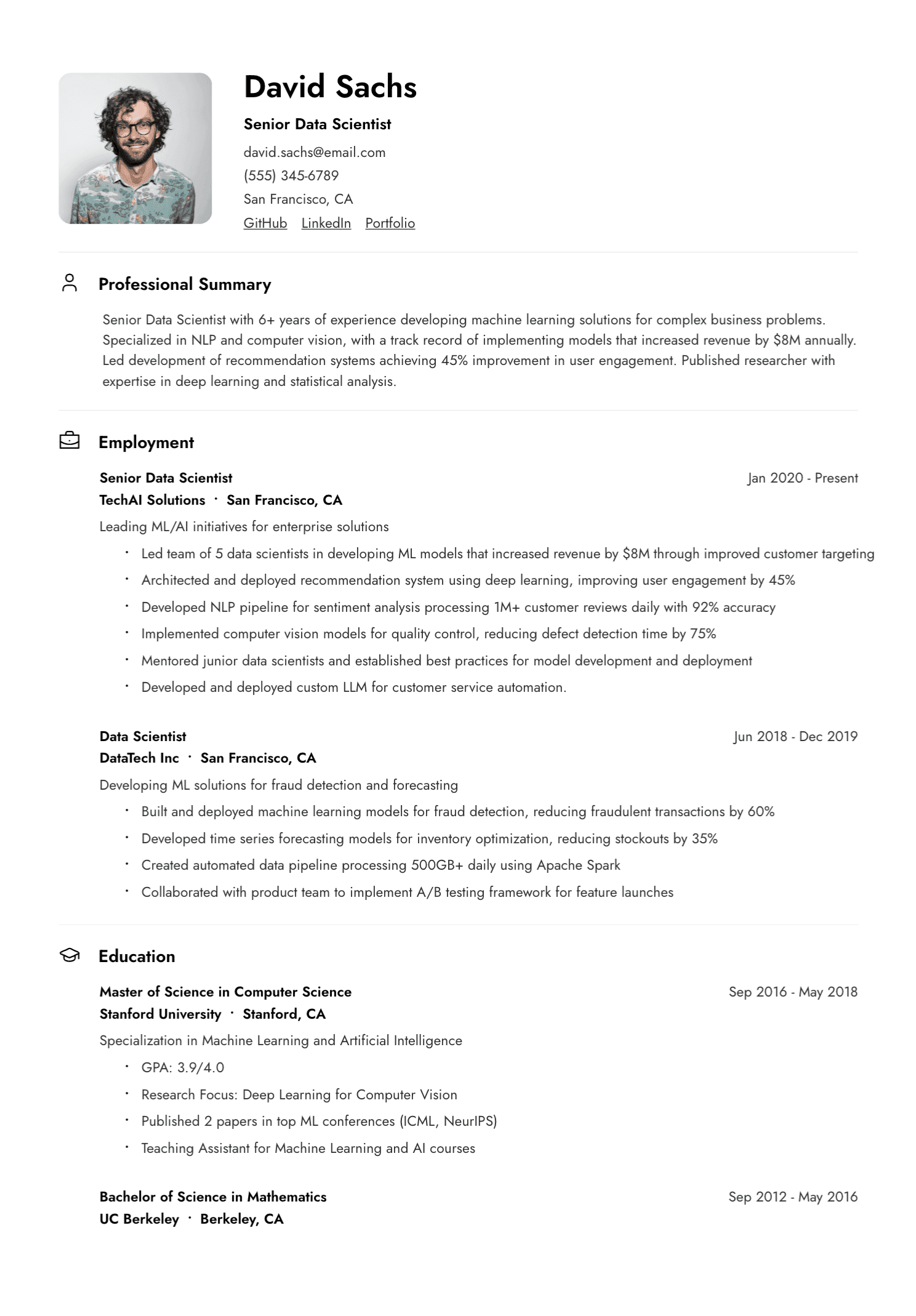
Your professional summary as a data scientist should effectively balance technical expertise with business acumen, immediately highlighting your ability to derive actionable insights from complex data. This section must capture attention by showcasing your most impactful projects, modeling expertise, and demonstrated business value creation. For senior roles, emphasize machine learning systems deployed and teams led; for mid-level positions, focus on successful models and analyses; for entry-level roles, highlight strong theoretical foundations and practical projects. Quantify achievements with specific metrics while maintaining clarity and impact. Customize this section based on the specific role and industry, highlighting relevant domains and technical specialties. The summary should demonstrate not just your technical capabilities, but how your analyses and models have driven business decisions and improvements.
Senior Data Scientist Summary Guide
For senior roles, your summary should emphasize three key elements: technical leadership in machine learning, end-to-end project ownership, and business impact. Focus on models deployed to production, teams led, and concrete improvements achieved.
Senior Data Scientist with 8+ years of experience developing and deploying machine learning solutions at scale. Led development of recommendation engine driving $50M+ in additional revenue through improved user engagement. Expert in deep learning and NLP, with proven track record of mentoring teams and implementing MLOps practices that reduced model deployment time by 70%.
Principal Data Scientist specializing in computer vision and deep learning. 10+ years of experience leading AI initiatives at scale, including development of real-time object detection system processing 1M+ images daily with 98% accuracy. Expertise in PyTorch, TensorFlow, and distributed training, reducing model training costs by $300K annually.
Lead with your most senior title and years of experience
Include specific ML domains and technologies where you excel
Quantify impact with concrete metrics (revenue increase, accuracy improvements)
Highlight both product and leadership achievements
Keep it under 4 lines for optimal readability
Mid-Level Data Scientist Summary Guide
Mid-level data scientists should focus on successful projects and growing technical expertise. Highlight your end-to-end project ownership and specific technical challenges solved.
Data Scientist with 4 years of experience developing machine learning solutions for financial services. Architected and deployed fraud detection model processing $100M+ daily transactions with 99.5% accuracy. Reduced false positives by 40% through innovative feature engineering and ensemble modeling techniques.
Machine Learning Engineer with 3 years specializing in NLP and text analytics. Led development of sentiment analysis pipeline processing 1M+ customer reviews monthly with 92% accuracy. Improved model training efficiency by 5x through implementation of distributed training and automated feature selection.
Entry-Level Data Scientist Summary Guide
For entry-level positions, focus on your educational background, internships, and projects. Emphasize your strong theoretical foundation and practical applications.
Data Science graduate with strong foundation in machine learning, statistics, and software engineering. Completed 2 internships at tech companies, developing and deploying ML models using Python, TensorFlow, and AWS. Active Kaggle competitor with 3 competition medals and published research in natural language processing.
Recent Masters in Data Science graduate with hands-on experience in machine learning through multiple research projects and internships. Developed customer churn prediction model achieving 85% accuracy, leading to projected annual savings of $200K. Proficient in Python, R, and SQL with demonstrated ability to quickly master new technologies.
Highlight relevant coursework and research projects
Emphasize internship experiences and concrete contributions
Showcase competition achievements and personal projects
Demonstrate enthusiasm for continuous learning
Include specific technologies and ML frameworks used
Build a data scientist resume like this
Use this example as a starting point, then tailor the content, keywords, and layout around the job description you are applying to.
Technical Skills Section
The technical skills section for a data scientist must strategically showcase both breadth and depth across machine learning, statistics, and programming while ensuring ATS compatibility. Organize skills by domain (ML/AI, Statistics, Programming, etc.) and indicate proficiency levels where relevant. For senior positions, emphasize advanced modeling techniques and architectural decisions alongside specific technologies. Include both traditional statistical methods and cutting-edge ML approaches to demonstrate a strong theoretical foundation combined with practical expertise. The key is to present a comprehensive yet focused picture of your technical capabilities, always considering the specific requirements of target positions. Remember to include both hard technical skills and methodological approaches, from specific programming languages to experimental design and model deployment practices.
Organizing Technical Skills
Structure your skills in clear categories relevant to data science roles:
Machine Learning/AI: Deep Learning, NLP, Computer Vision, Reinforcement Learning, Time Series Analysis
Statistics & Mathematics: Statistical Testing, Experimental Design, Bayesian Methods, Linear Algebra
Programming Languages: Python (PyTorch, TensorFlow, scikit-learn), R (tidyverse, caret), SQL
Big Data & Cloud: Spark, Hadoop, AWS (SageMaker), GCP (Vertex AI), Azure ML
Data Visualization: Tableau, Power BI, Matplotlib, Seaborn, D3.js
MLOps & Tools: Docker, Git, MLflow, Kubeflow, DVC, Weights & Biases
Advanced Technical Competencies
For senior roles, include high-level technical competencies that demonstrate deep expertise:
Machine Learning: Model Architecture Design, Transfer Learning, Few-shot Learning, AutoML
MLOps: Model Monitoring, A/B Testing, Feature Stores, Model Registry
Big Data: Distributed Computing, Data Pipeline Design, Stream Processing
Research: Paper Implementation, Experimental Design, Literature Review
Development Practices: CI/CD for ML, Code Review, Documentation
Soft Skills for Data Scientists
Include essential non-technical skills crucial for data science roles:
Communication: Data Storytelling, Technical Writing, Stakeholder Presentations
Project Management: Agile/Scrum, Sprint Planning, Resource Allocation
Business Acumen: ROI Analysis, KPI Definition, Requirements Gathering
Leadership: Team Mentoring, Cross-functional Collaboration, Project Planning
Problem Solving: Hypothesis Testing, Root Cause Analysis, Solution Design
Professional Experience Section
Your professional experience section must demonstrate progression in technical complexity and business impact through concrete, quantifiable achievements. Each role should showcase your ability to translate data insights into business value while highlighting technical expertise in machine learning and analytics. Focus on end-to-end project ownership, from problem definition to model deployment and monitoring. Include details about the scale of data processed, model performance metrics, and business impact achieved. Demonstrate your ability to work across the full machine learning lifecycle, from data collection and preprocessing to model deployment and maintenance. For each position, highlight not just what technologies you used, but why you chose them and what results they delivered.
Senior Role Experience Example
For senior positions, emphasize leadership, end-to-end project ownership, and business impact.
Senior Data Scientist | AI Solutions Inc. | 2020-Present
Lead data scientist for customer intelligence platform serving Fortune 500 clients
- Architected and deployed recommendation system processing 10M+ daily user interactions with 45% CTR improvement
- Led team of 5 data scientists in developing customer segmentation model increasing marketing ROI by 85%
- Implemented automated ML pipeline reducing model training time from 1 week to 6 hours
- Developed real-time anomaly detection system achieving 96% accuracy in fraud prevention
- Established MLOps practices reducing model deployment time by 60%
Technologies: Python, TensorFlow, AWS SageMaker, Spark, MLflow, Docker
Mid-Level Experience Example
For mid-level positions, focus on project execution and growing technical impact.
Data Scientist | StartupTech | 2018-2020
Data scientist for predictive analytics platform
- Built and deployed customer churn prediction model achieving 88% accuracy
- Developed NLP pipeline processing 100K+ customer reviews monthly
- Implemented A/B testing framework increasing experiment velocity by 300%
- Created automated feature engineering pipeline reducing model development time by 50%
- Collaborated with engineering team to deploy 5 ML models to production
Key Skills: Python, scikit-learn, NLP, A/B Testing, Feature Engineering
Machine Learning Engineer | Tech Solutions | 2016-2018
ML engineer for recommendation systems
- Built recommendation engine increasing user engagement by 35%
- Optimized model training pipeline reducing costs by 40%
- Implemented real-time prediction API handling 10K+ requests per second
- Developed data quality monitoring system reducing data issues by 70%
Key Focus: Recommendation Systems, Model Deployment, API Development
Projects and Technical Achievements
Your projects section should showcase your ability to solve complex data science problems and deliver measurable business impact. Each project should tell a complete story: the business problem addressed, the technical approach taken, the modeling decisions made, and the quantifiable results achieved. Focus on projects that demonstrate expertise in relevant areas like machine learning, statistical analysis, and data engineering. Include both professional and personal projects that show initiative and technical creativity. For each project, detail the full machine learning lifecycle, including data preparation, model selection, validation strategy, and deployment considerations. This section should demonstrate not just what you built, but how you approached complex analytical challenges and what insights you gained.
Project Presentation Guide
Each project should clearly communicate the problem solved, methodology used, and quantifiable results.
Customer Churn Prediction System
Problem: High customer churn rate causing $2M+ annual revenue loss
- Developed ensemble ML model achieving 88% accuracy in predicting customer churn
- Implemented automated feature engineering pipeline processing 50+ customer behavior metrics
- Reduced customer churn by 35% through targeted intervention strategies
- Deployed model via REST API handling 10K+ daily predictions
Technologies: Python, scikit-learn, XGBoost, FastAPI, PostgreSQL
Real-time Market Sentiment Analysis
Problem: Manual processing of market sentiment data causing delayed trading decisions
- Built NLP pipeline processing 100K+ financial news articles daily
- Achieved 92% accuracy in sentiment classification using BERT-based model
- Reduced sentiment analysis latency from hours to seconds
- Implemented streaming architecture for real-time market insights
Technologies: Python, PyTorch, Kafka, Elasticsearch, Docker
Research and Competition Achievements
Highlight academic research and data science competition successes.
Published Research: 'Novel Approaches to Few-Shot Learning in Computer Vision' - cited 100+ times
Kaggle Competitions: 2 gold medals in NLP challenges, top 1% ranking
Patent Pending: 'Efficient Method for Real-time Anomaly Detection in Time Series Data'
Open Source: Created popular data augmentation library with 10K+ GitHub stars
Industry Recognition: Best Paper Award at ML Conference 2023
Education and Technical Certifications
The education section for a data scientist should emphasize both theoretical foundations and practical applications. Focus on relevant coursework in statistics, machine learning, and computer science. For advanced degrees, highlight research work and publications that demonstrate expertise in specific domains. Technical certifications should be strategically chosen to show proficiency in industry-standard tools and platforms. Include not just the certification names but also any significant projects or implementations that resulted from this knowledge. Remember to highlight any academic projects that involved real-world data analysis, collaborations with industry partners, or innovative machine learning applications. This section should demonstrate both your theoretical understanding and your ability to apply advanced analytical concepts to practical problems.
Education Presentation
Present your education with emphasis on relevant coursework and research.
Ph.D. in Machine Learning | Tech University | 2018-2022 • Dissertation: 'Advanced Techniques in Self-Supervised Learning for Computer Vision' • Published 3 papers in top-tier ML conferences (NeurIPS, ICML) • Research Focus: Deep Learning, Computer Vision, Transfer Learning • Key Projects: - Developed novel few-shot learning algorithm achieving SOTA results - Created efficient data augmentation techniques for limited datasets - Collaborated with industry partners on real-world ML applications
Master of Science in Data Science | State University | 2016-2018 • GPA: 3.95/4.0 • Relevant Coursework: Advanced Machine Learning, Statistical Learning Theory, Deep Learning • Thesis: 'Efficient Methods for Large-Scale Time Series Analysis' • Awards: Outstanding Graduate Research Award, Data Science Fellowship
Professional Certifications
List certifications that demonstrate expertise in relevant technologies and methodologies.
AWS Machine Learning Specialty Certification
Google Cloud Professional Data Engineer
TensorFlow Developer Certificate
Databricks Certified Machine Learning Professional
Deep Learning Specialization - deeplearning.ai
Resume Optimization and Formatting
A data scientist's resume must balance technical depth with clarity while ensuring compatibility with both ATS systems and human readers. This requires strategic formatting and keyword optimization specific to data science roles. Use industry-standard section headings and naturally incorporate relevant machine learning and statistical terms throughout your resume. The layout should guide readers through your progression in data science while keeping critical information easily scannable. Consider your audience's technical background - include enough detail to demonstrate expertise while keeping descriptions accessible to non-technical recruiters. Pay special attention to formatting consistency, especially with technical terms and metrics. Use a clean, professional font and maintain adequate white space to enhance readability. Remember to include links to your GitHub profile, Kaggle account, or research publications, ensuring they're properly formatted for both digital and printed versions.
ATS Optimization for Data Science Roles
Ensure your resume passes Applicant Tracking Systems while maintaining readability.
Include key ML/AI terms from job descriptions (e.g., 'machine learning', 'deep learning', 'neural networks')
Use standard section headings (Experience, Skills, Education)
Spell out abbreviations at least once (e.g., 'Natural Language Processing (NLP)')
Avoid tables and complex formatting that may confuse ATS
Include both tool names and concepts (e.g., 'PyTorch', 'convolutional neural networks')
List both full and abbreviated versions of certifications (e.g., 'AWS Certified Solutions Architect - Associate (AWS-SAA)')
Data Science Resume Best Practices
Format your resume to effectively showcase your analytical and technical expertise.
Lead with impactful metrics (accuracy rates, performance improvements, business impact)
Include links to published papers, GitHub repositories, and Kaggle profiles
Organize projects by type (ML Engineering, Research, Analytics)
Highlight both technical skills and business impact
Keep mathematical notation minimal and clear
Use consistent formatting for model performance metrics
Common Data Science Resume Mistakes
Avoid these common pitfalls in data science resumes:
Listing algorithms without showing practical applications
Focusing on tools rather than problem-solving approaches
Neglecting to explain business impact of models
Using excessive technical jargon in executive summaries
Omitting model performance metrics and validation strategies
Failing to demonstrate end-to-end project ownership
Make your experience impossible to miss.
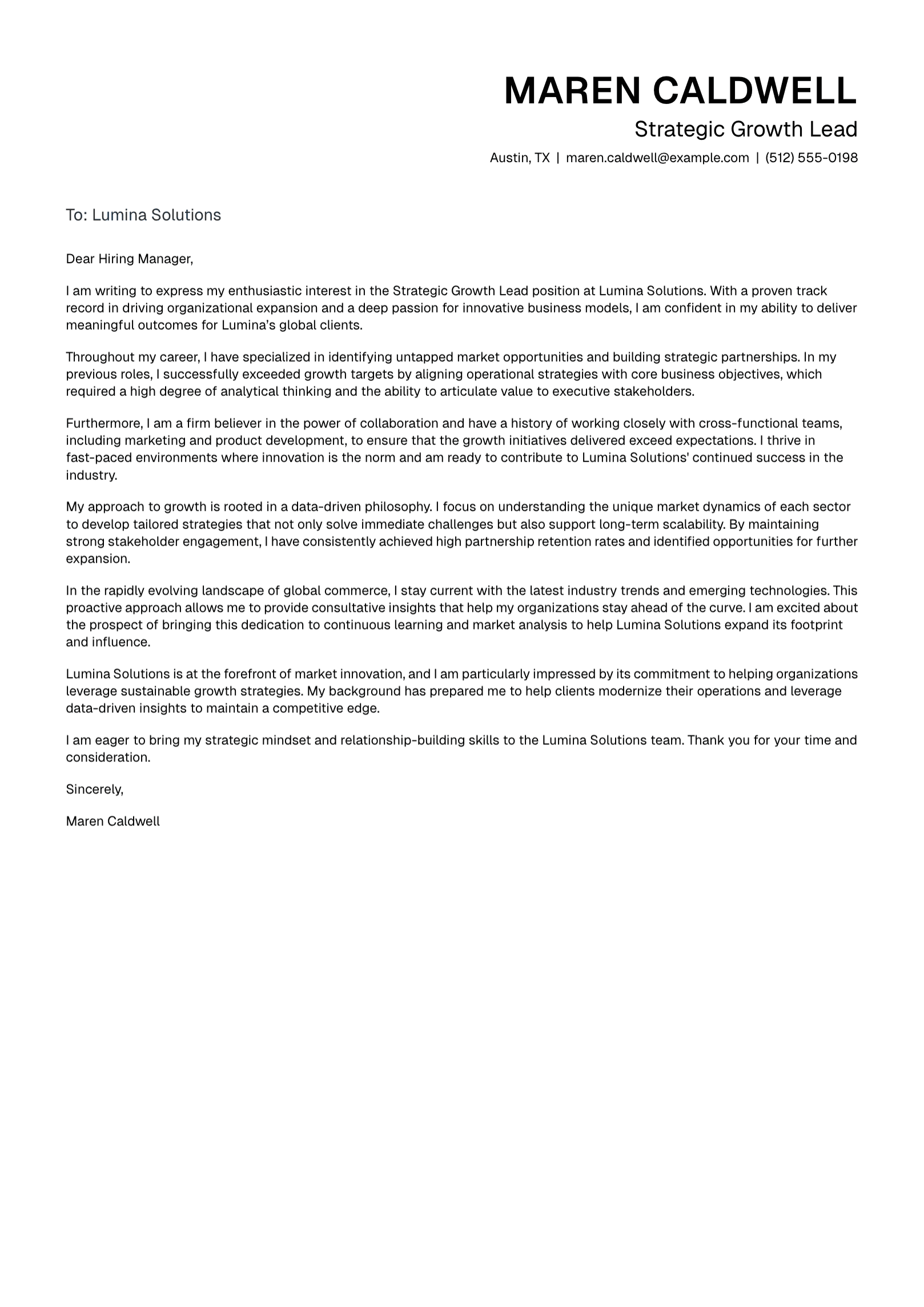
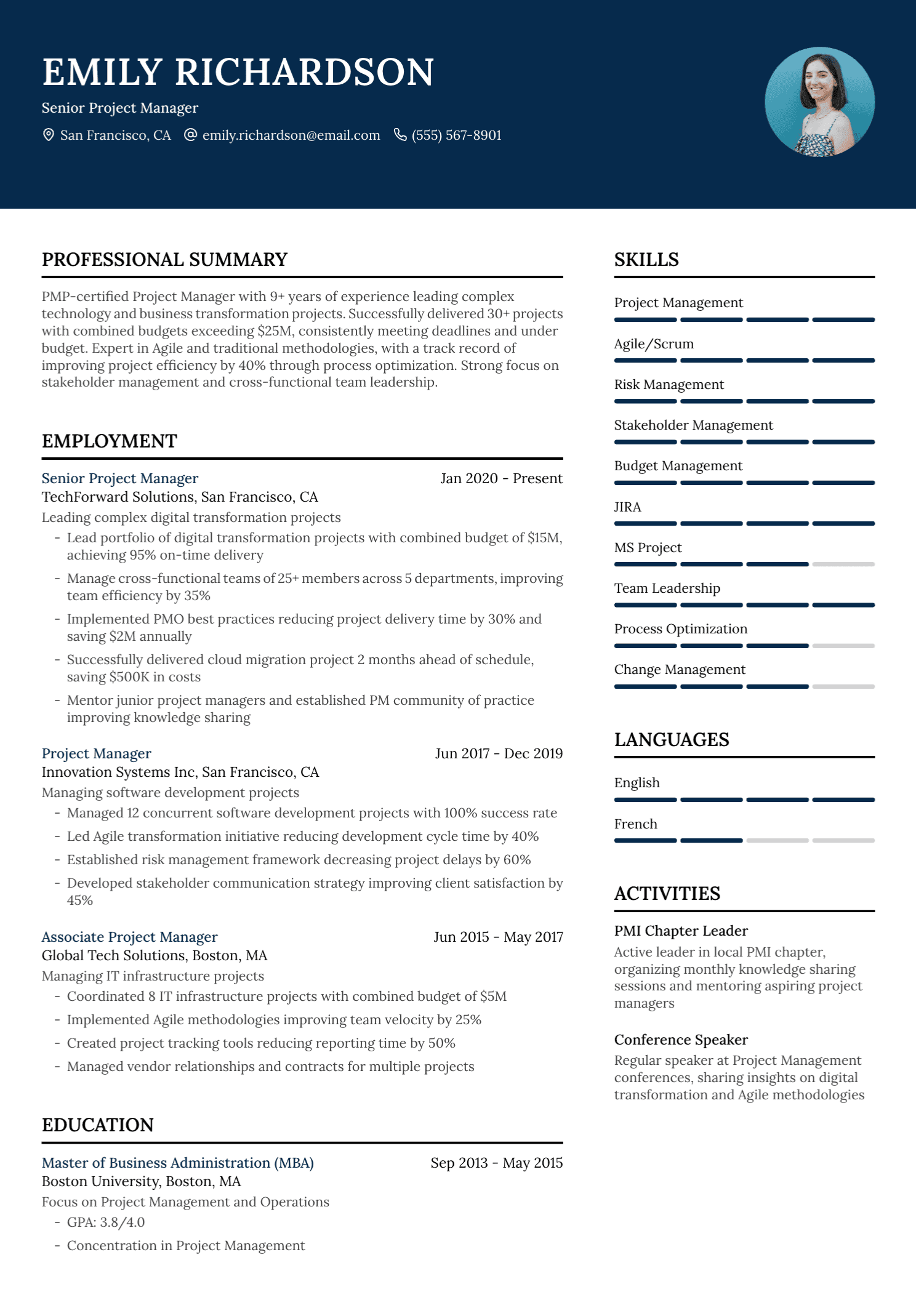
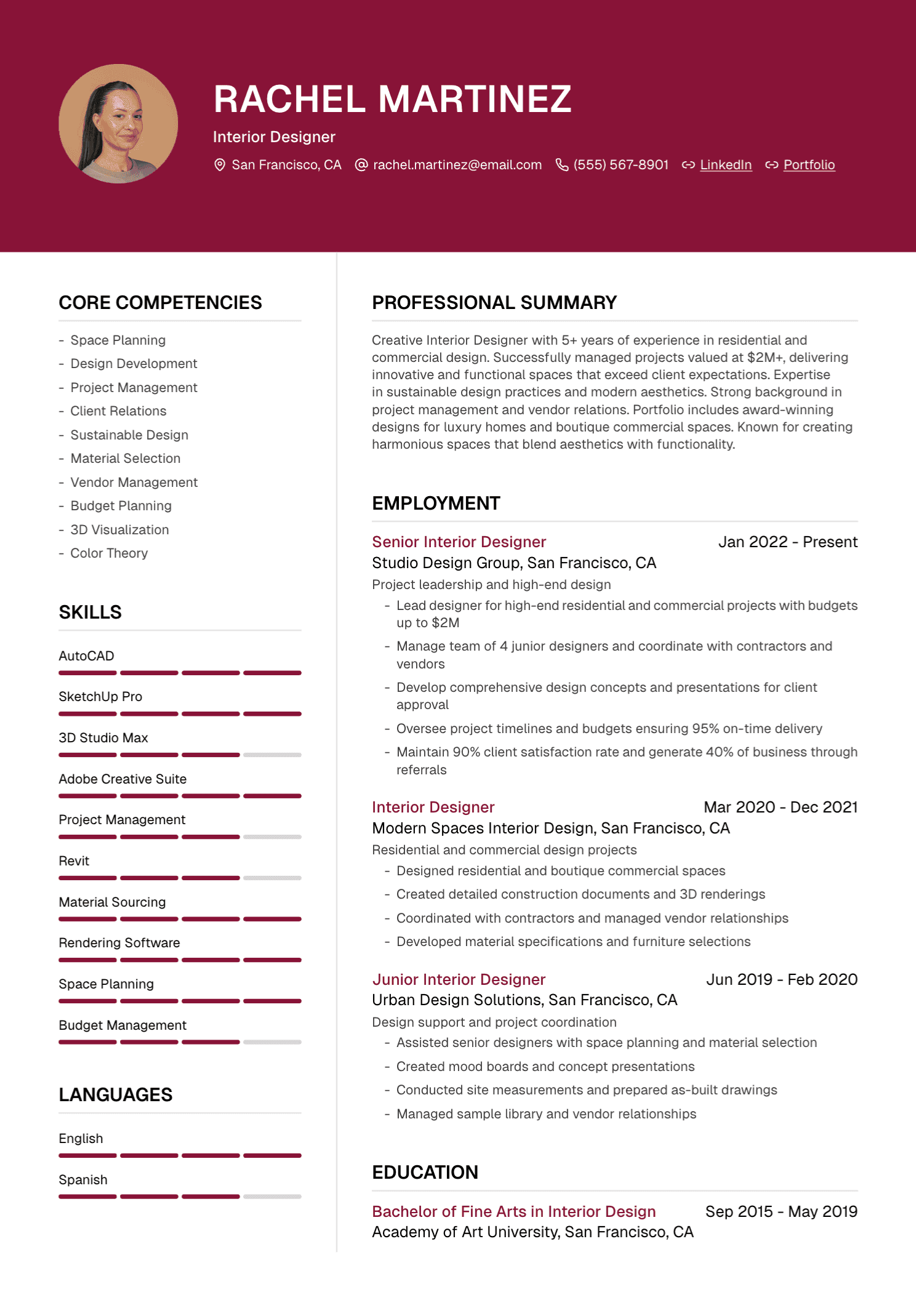
Build an ATS-friendly resume tailored to the job, create a matching cover letter, and be ready to apply in minutes.
4.58/5
49,000+ job seekers
Start for free · No credit card required