
Detailed Guide on How to Write a Electrician Resume
Review a electrician resume example, then build a targeted version with AI or check your current resume score.
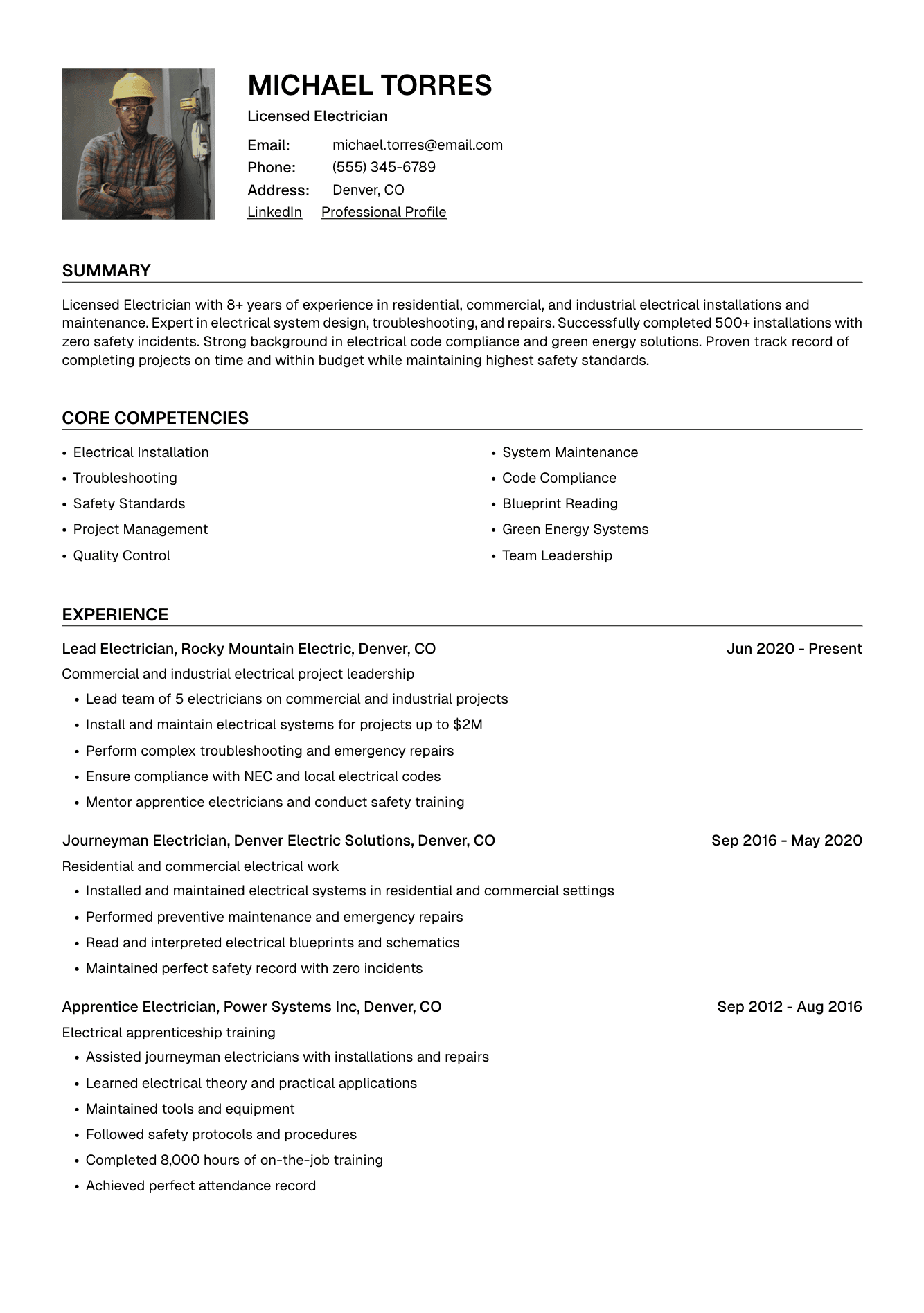
Professional Summary for Electricians
Your professional summary as an electrician must effectively communicate your technical expertise and hands-on experience. This crucial section needs to immediately capture attention by highlighting your most significant electrical work achievements, safety record, and specialized skills. For master electricians, focus on leadership and complex projects; for journeymen, emphasize technical expertise and project experience; for apprentices, showcase your training progress and practical skills. The key is to quantify achievements with concrete metrics while demonstrating both technical proficiency and safety consciousness. Remember to customize this section based on the specific type of electrical work and industry sector required.
Master Electrician Summary Guide
For master electrician roles, your summary should emphasize three key elements: technical expertise, leadership, and project management.
Master Electrician Example
Licensed Master Electrician with 15+ years of experience in commercial and industrial electrical systems.
- Led teams of 10+ electricians on projects valued up to $2M, maintaining perfect safety record
- Specialized in high-voltage installations, automated control systems, and electrical system design
- Consistently completed projects 10% under budget
Industrial Master Electrician Example
Master Electrician with 12+ years specializing in industrial automation and power distribution.
- Managed electrical operations for manufacturing facilities with 500,000+ square feet
- Implemented preventive maintenance programs reducing downtime by 40%
- Saved $300K annually in operational costs
Lead with your highest electrical license level and years of experience
Include specific types of electrical systems and industries served
Quantify impact with concrete metrics (project values, safety records)
Highlight both technical expertise and leadership achievements
Keep it under 4 lines for optimal readability
Journeyman Electrician Summary Guide
Journeymen should focus on technical skills and project experience. Highlight your ability to handle complex installations and maintain safety standards.
Journeyman Electrician Example
Licensed Journeyman Electrician with 6 years of experience in commercial and residential electrical installations.
- Completed 200+ successful projects including office buildings, retail spaces, and custom homes
- Maintained 100% compliance with NEC standards
- Zero safety incidents over 12,000+ hours of electrical work
Commercial Journeyman Electrician Example
Commercial Journeyman Electrician with 5 years specializing in green energy systems.
- Installed and maintained solar power systems for 50+ commercial properties
- Reduced client energy costs by average of 35%
- Expert in troubleshooting complex electrical issues with 98% first-time resolution rate
Apprentice Electrician Summary Guide
For apprentices and entry-level positions, focus on training progress, practical experience, and eagerness to learn.
Third-Year Electrical Apprentice Example
Third-year Electrical Apprentice with 4,000+ hours of hands-on experience in residential and light commercial installations.
- Completed 75% of required coursework with 3.9 GPA
- Assisted in 100+ successful electrical installations including new construction and renovation projects
Electrical Apprentice Example
Electrical Apprentice with strong foundation in electrical theory and 2,000+ hours of practical experience.
- Proficient in reading blueprints, installing conduit systems, and performing basic troubleshooting
- Maintained perfect attendance record
- Consistently received positive feedback for attention to detail and safety consciousness
Highlight apprenticeship progress and training achievements
Emphasize hands-on experience and practical skills
Showcase safety awareness and attention to detail
Demonstrate willingness to learn and grow
Include relevant pre-apprenticeship experience or training
Build a electrician resume like this
Use this example as a starting point, then tailor the content, keywords, and layout around the job description you are applying to.
Skills Section for Electricians
The skills section of an electrician's resume must effectively showcase your technical expertise across various electrical systems and safety protocols. Organize skills by key electrical competencies, from installation and maintenance to safety and compliance. For master electricians, emphasize advanced technical knowledge and leadership capabilities. Include both technical skills specific to electrical work and essential soft skills that demonstrate your ability to work safely and efficiently. The key is to present a well-rounded skill set that shows you can handle all aspects of electrical work, from basic installations to complex troubleshooting.
Core Technical Skills
Structure your technical skills in categories essential for electrical work:
Electrical Systems: Circuit Installation, Power Distribution, Voltage Systems (Low/High), Motor Controls
Installation & Maintenance: Conduit Systems, Wiring, Circuit Breakers, Electrical Panels, Transformers
Troubleshooting: Diagnostic Equipment, Circuit Testing, Power Quality Analysis, Fault Finding
Safety & Compliance: NEC Standards, OSHA Regulations, Lock-out/Tag-out, PPE Protocols
Tools & Equipment: Digital Multimeters, Power Tools, Hand Tools, Testing Equipment
Technical Documentation: Blueprint Reading, Electrical Diagrams, Permit Documentation
Advanced Technical Competencies
For master electricians, highlight advanced technical skills:
System Design: Electrical System Planning, Load Calculations, Power Distribution Design
Specialized Systems: Industrial Controls, PLC Programming, HVAC Controls, Fire Alarm Systems
Project Management: Cost Estimation, Material Planning, Quality Control, Team Supervision
Green Energy: Solar Installation, Energy Efficiency, Smart Building Systems
Advanced Technologies: Building Automation, Industrial Automation, Smart Grid Systems
Essential Soft Skills
Highlight crucial interpersonal and professional skills for electricians:
Safety Leadership: Risk Assessment, Safety Protocol Implementation, Emergency Response
Communication: Client Relations, Team Coordination, Technical Explanation
Problem Solving: Analytical Thinking, Troubleshooting, Critical Decision Making
Work Ethics: Attention to Detail, Time Management, Reliability
Physical Capabilities: Manual Dexterity, Physical Stamina, Hand-Eye Coordination
Professional Experience Section
Your professional experience section must tell a compelling story of your electrical career through concrete achievements and measurable impacts. Each role should demonstrate progression in technical complexity, project scope, and safety responsibility. Focus on showcasing successful installations, maintenance programs, and your ability to handle complex electrical systems. Include details about project values, safety records, and key improvements achieved. Demonstrate your ability to work across various electrical systems while maintaining the highest safety standards.
Master Electrician Experience Example
For master electrician positions, emphasize leadership, complex projects, and safety management.
Master Electrician | Industrial Electric Co. | 2018-Present
Lead electrician for large-scale industrial and commercial projects
- Managed electrical installations for $5M manufacturing facility upgrade project
- Supervised team of 12 electricians maintaining zero safety incidents over 25,000 work hours
- Implemented preventive maintenance program reducing downtime by 45%
- Designed and installed energy-efficient lighting systems saving clients $200K annually
- Maintained 100% compliance with NEC and OSHA regulations
Specialties: Industrial Controls, High-Voltage Systems, Team Leadership
Senior Electrician | Power Systems LLC | 2015-2018
Project lead for commercial electrical installations
- Completed 50+ commercial projects ranging from $50K to $1.5M in value
- Developed and implemented safety protocols reducing incident rate by 75%
- Trained and mentored 8 apprentice electricians through certification
- Introduced energy monitoring systems reducing client power consumption by 30%
Specialties: Commercial Systems, Project Management, Safety Training
Journeyman Electrician Experience Example
For journeyman positions, focus on technical skills and project execution.
Journeyman Electrician | City Electric Services | 2019-Present
Commercial and residential electrical installation specialist
- Completed 150+ residential and light commercial installations with zero callbacks
- Installed and maintained electrical systems for 20+ retail locations
- Performed successful troubleshooting reducing average repair time by 35%
- Maintained perfect safety record across 200+ service calls
- Specialized in energy-efficient lighting upgrades and smart home systems
Specialties: Installation, Troubleshooting, Code Compliance
Commercial Electrician | Building Systems Inc. | 2017-2019
Focused on commercial electrical installations and maintenance
- Installed electrical systems in 15 new commercial buildings
- Upgraded lighting systems in 30+ offices to LED technology
- Performed emergency repairs with 98% first-time fix rate
- Maintained detailed documentation ensuring code compliance
Specialties: Commercial Wiring, Lighting Systems, Emergency Repairs
Education and Certifications
The education section for an electrician should emphasize both formal training and professional certifications. Focus on your apprenticeship program, technical education, and ongoing professional development. For licensed electricians, highlight your progression through various license levels and specialized certifications. Professional certifications should demonstrate your expertise in specific electrical systems and safety protocols. Include not just the certification names but also any significant specializations or endorsements obtained.
Education Presentation
Present your education with emphasis on electrical training and achievements.
Electrical Technology Program | Technical Institute | 2015-2017
- Completed 8,000-hour Apprenticeship Program
- Achieved perfect attendance and 3.9 GPA
- Key Training Areas: Electrical Theory and Mathematics, Blueprint Reading and Circuit Design, National Electrical Code (NEC), Safety and OSHA Regulations
- Specialized Training: Industrial Controls, Motor Controls, PLC Programming
Electrical Apprenticeship | ABC Electrical Contractors | 2016-2020
- Completed 4-year apprenticeship program with 8,000 hours of on-the-job training
- Maintained 95% average in technical coursework
- Received Outstanding Apprentice Award
- Specialized in commercial and industrial electrical systems
- Completed additional training in renewable energy systems
Professional Licenses and Certifications
List licenses and certifications that demonstrate electrical expertise.
Master Electrician License - State of [State]
Journeyman Electrician License
OSHA 30-Hour Construction Safety Certification
National Electric Code (NEC) Certification
First Aid and CPR Certification
Lift Equipment Operation Certification
Arc Flash Safety Certification
Solar PV Installation Certification
Professional Development
Highlight ongoing learning and industry engagement.
Member of International Brotherhood of Electrical Workers (IBEW)
Regular attendee at National Electrical Contractors Association (NECA) conferences
Certified Safety Trainer for apprentice electricians
Continuing education in emerging electrical technologies
Active participant in electrical code update training
Projects and Electrical Achievements
Your projects section should showcase your ability to handle complex electrical installations and maintenance projects. Each project should tell a complete story: the technical challenge addressed, the solution implemented, the safety measures taken, and the quantifiable outcomes achieved. Focus on projects that demonstrate your technical expertise, problem-solving abilities, and commitment to safety. Include both large-scale installations and challenging troubleshooting projects that showcase your versatility. For each project, detail the full scope of work, including planning, installation, testing, and compliance verification.
Project Presentation Guide
Each project should clearly communicate the challenge, solution, and impact.
Manufacturing Facility Upgrade
Challenge: Outdated electrical system causing frequent downtime and safety concerns
- Conducted comprehensive electrical system assessment
- Designed and installed new 480V power distribution system
- Upgraded lighting to energy-efficient LED systems
- Implemented automated control systems
- Reduced facility downtime by 75%
- Achieved $150K annual energy savings
- Eliminated all safety incidents
- Completed project 2 weeks ahead of schedule
Specialties: Industrial Power, Safety Systems, Project Management
Commercial Building Renovation
Challenge: Integration of modern electrical systems in historic building
- Designed custom installation plan preserving historical features
- Installed new service entrance and distribution panels
- Implemented smart lighting and control systems
- Coordinated with historical preservation requirements
- Maintained building's historical integrity
- Reduced energy consumption by 40%
- Achieved perfect inspection score
- Completed within budget and timeline
Specialties: Commercial Systems, Historical Preservation, Code Compliance
Specialized Project Highlights
Highlight projects that demonstrate technical expertise and problem-solving.
Data Center Installation: Designed and installed redundant power systems for 50,000 sq ft facility
Solar Integration: Completed 20+ commercial solar power installations totaling 2MW capacity
Emergency Systems: Installed hospital backup power systems with 10-second switchover
Industrial Automation: Implemented PLC-controlled manufacturing systems reducing downtime by 60%
Energy Efficiency: Led lighting retrofit projects saving clients $500K+ annually
Safety and Quality Achievements
Showcase achievements that demonstrate safety leadership and quality work.
Safety Record: Maintained zero incidents across 50,000+ work hours
Quality Control: Achieved 100% inspection pass rate on first submission
Team Leadership: Trained 15+ apprentices with perfect safety records
Compliance: Maintained perfect OSHA compliance record for 5+ years
Emergency Response: Led emergency repair team with 30-minute average response time
Resume Optimization and Formatting
An electrician's resume must effectively balance technical expertise with practical experience while ensuring compatibility with both ATS systems and human readers. This requires thoughtful organization and clear presentation of your electrical career. Use industry-standard section headings and naturally incorporate relevant electrical terminology throughout your resume. The layout should guide readers through your progression as an electrician while keeping critical information easily scannable. Consider your audience - include enough technical detail to demonstrate expertise while keeping descriptions accessible to non-technical stakeholders. Pay special attention to formatting consistency, especially with safety records and project outcomes. Use a clean, professional font and maintain adequate white space to enhance readability. Remember to include your license numbers and certifications prominently, ensuring they're properly formatted for both digital and printed versions.
ATS Optimization for Electrical Roles
Ensure your resume passes Applicant Tracking Systems while maintaining readability for hiring managers.
Include key electrical terms naturally (e.g., 'electrical systems', 'circuit installation', 'NEC compliance')
Use standard section headings and clear formatting that won't confuse ATS systems
Include both technical terms and common variations (e.g., 'PLC/Programmable Logic Controller')
Electrician Resume Best Practices
Format your resume to effectively showcase your electrical expertise and safety record.
Strong Resume Structure Example
- Summary: Brief overview highlighting license level and key specialties
- Skills: Organized by electrical systems, safety, and technical abilities
- Experience: Focus on project achievements and safety records
- Certifications: Highlight licenses and safety certifications prominently
- Projects: Showcase significant installations with measurable results
Metrics Presentation Example
- Project Scale: 'Managed $2M electrical installation project'
- Safety: 'Maintained zero incidents across 25,000 work hours'
- Efficiency: 'Reduced troubleshooting time by 50%'
- Impact: 'Saved clients $200K through energy-efficient solutions'
Common Resume Mistakes
Avoid these common pitfalls in electrician resumes:
Listing licenses without current status or jurisdiction
Not emphasizing safety record and compliance history
Missing key metrics (project values, safety records, efficiency improvements)
Underemphasizing technical expertise and specializations
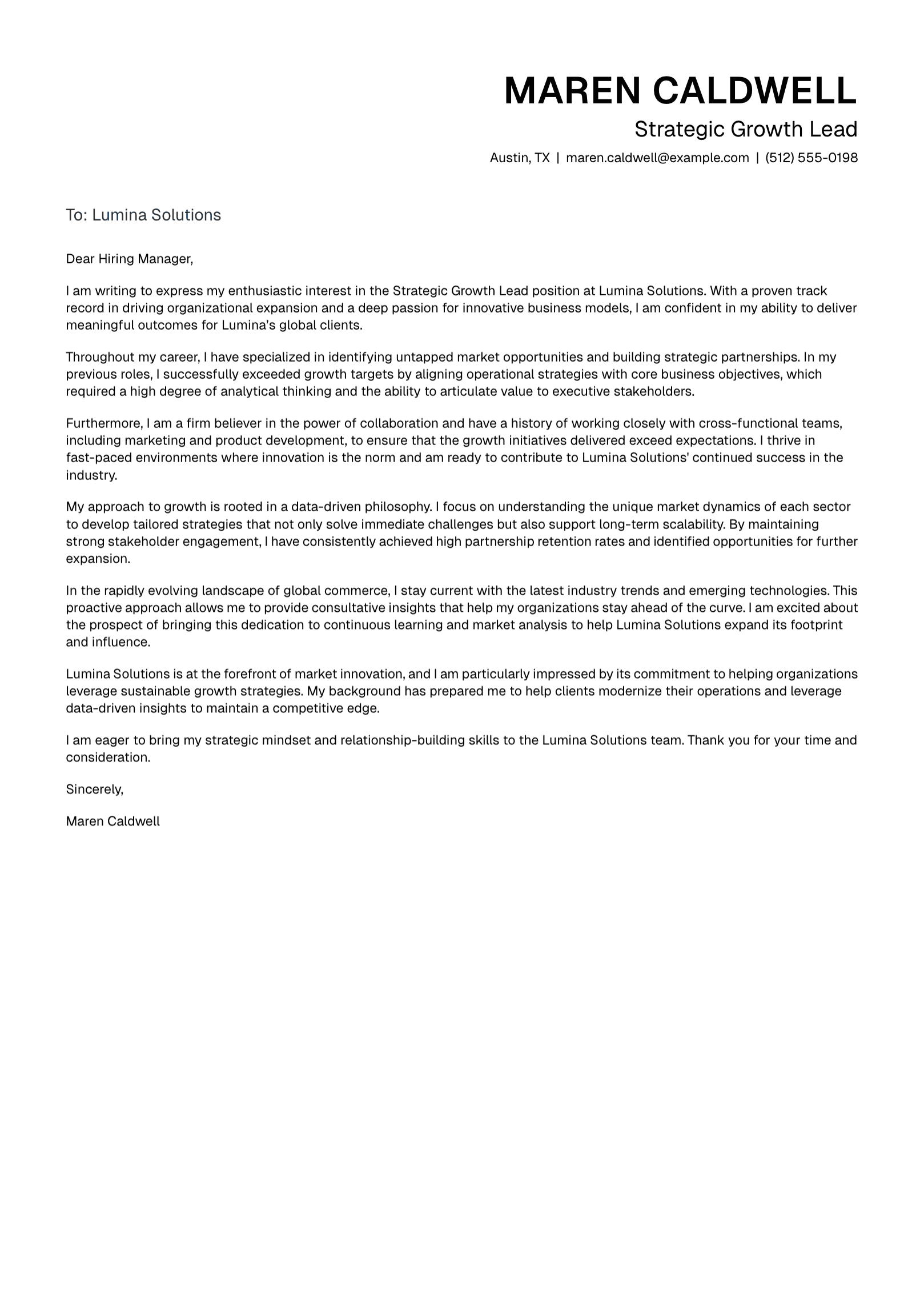
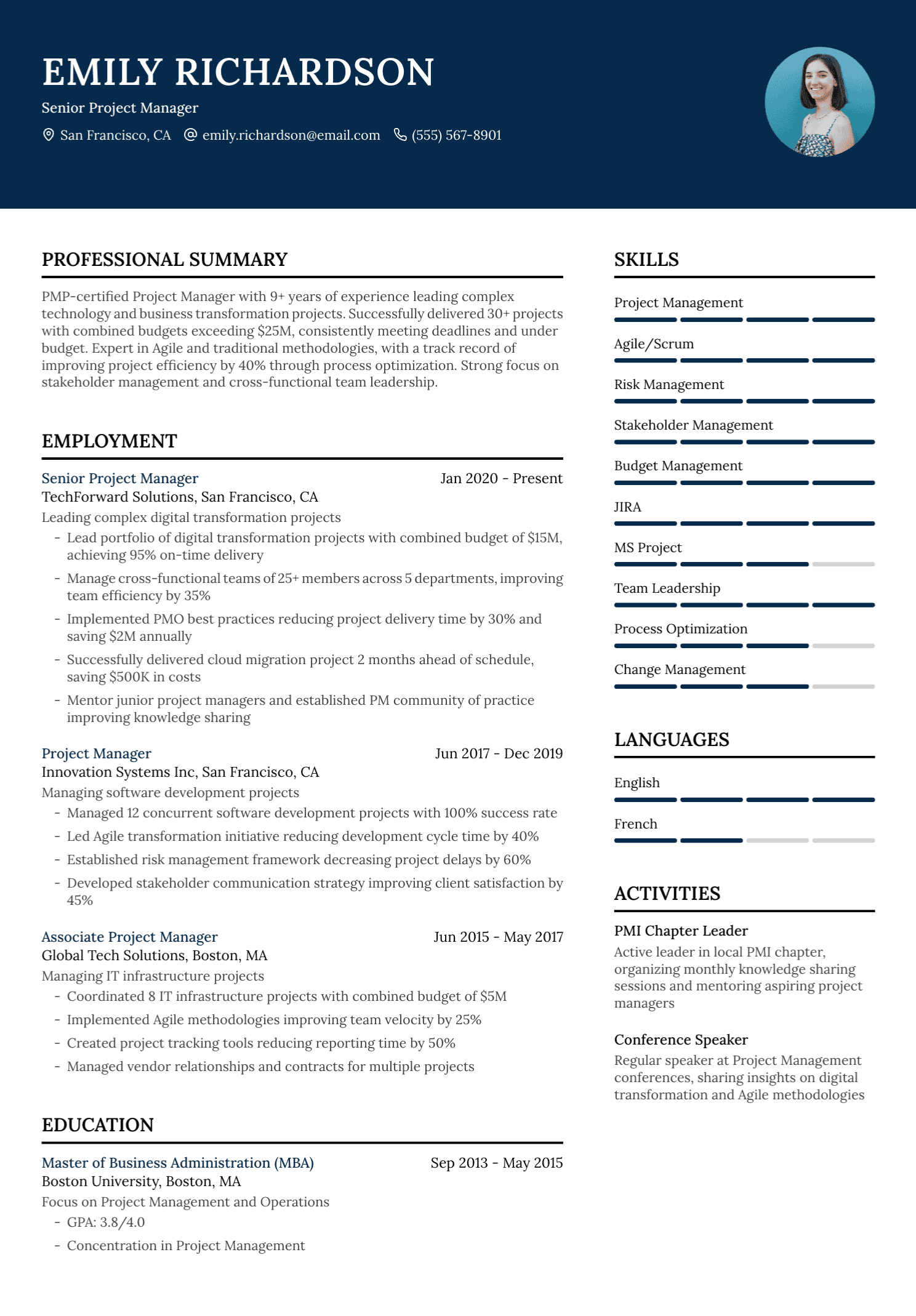
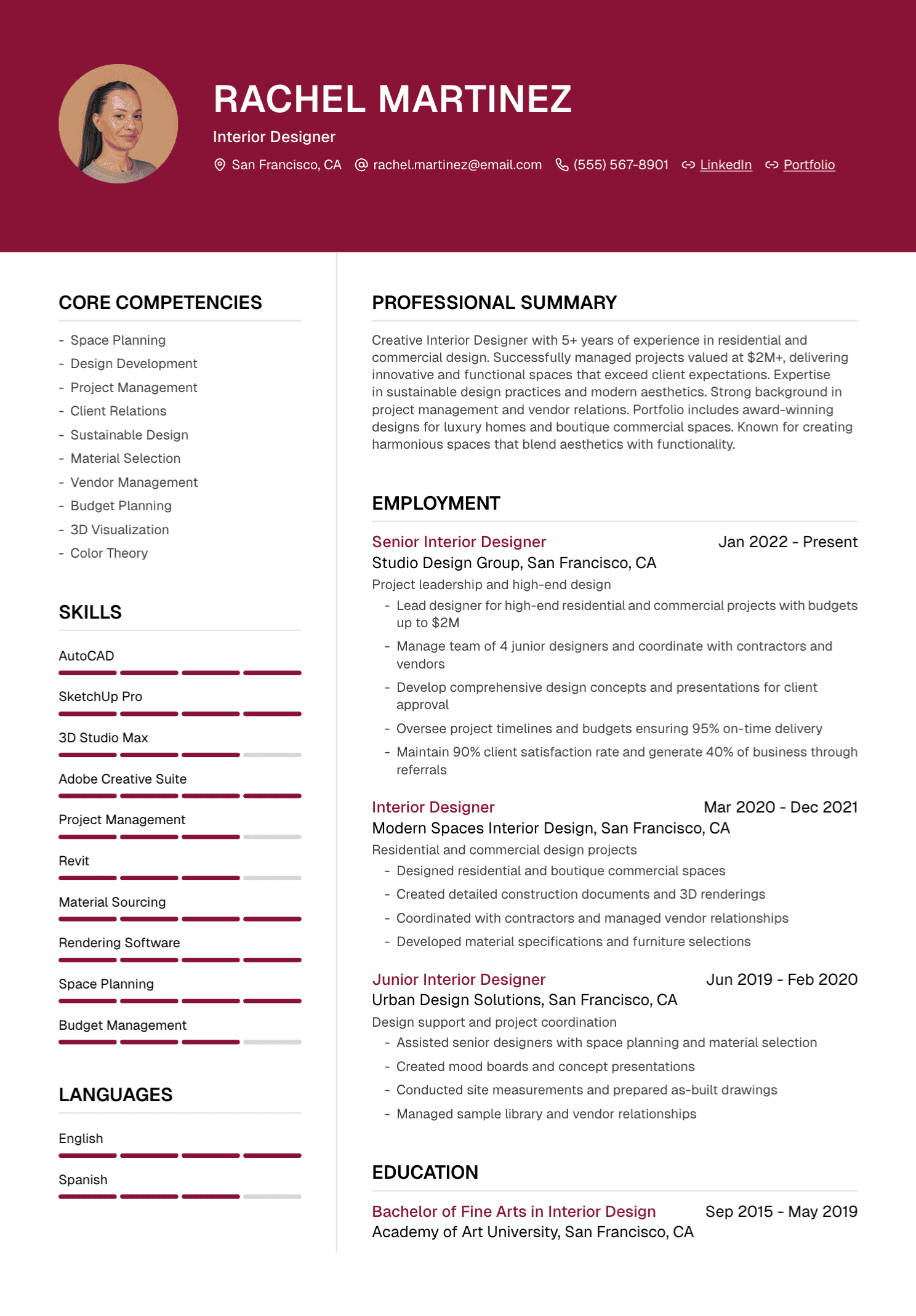
Make your experience impossible to miss.
Build an ATS-friendly resume tailored to the job, create a matching cover letter, and be ready to apply in minutes.
4.58/5
49,000+ job seekers
Start for free · No credit card required