The resume is uploaded, the work history has been typed into the form a second time, and one field remains. It is labeled “Cover letter (optional)”. The applicant has heard two things about that field, each from someone who sounded sure: that nobody reads cover letters anymore, and that leaving it empty is a quiet way to be passed over.
Whether cover letters are necessary is a question with evidence behind it, though little of that evidence reaches the advice pages. There are surveys of hiring managers, one field experiment with thousands of test applications, and two recent economics papers on what happened to written applications once a chatbot could produce them in seconds.
Read together, they give a reasonably clear answer. A cover letter is necessary when the employer asks for one, and rarely otherwise. It is useful more often than that. In the one experiment that tested it, run by a firm that sells cover letter writing, a letter written for the specific job raised interview callbacks by about half, while a generic letter barely moved them. And now that a fluent letter costs nothing to produce, a cover letter earns its place mainly by telling the reader something the resume cannot.
Two camps, both certain
The disagreement is easy to find. In February 2026 the Economic Times reported on a Reddit argument that began when one user claimed that giving up cover letters had brought more interview invitations. One commenter, in the paper’s summary, pointed out that every such discussion splits the same way: “some hiring managers swear they haven’t read one in years”, while “others insist they won’t consider a candidate without one”. Another, who hires for nonprofit policy work, said letters count as much as resumes for judging how a candidate communicates. A third offered a middle position: “Nobody reads them, but they all check if you made an effort to include one.”
Both camps may well be describing their own desks accurately. A recruiter working through several hundred applications for one opening and a director choosing a single policy analyst are doing different jobs. The pages that rank highest for the question mostly conclude that a letter is usually worth sending, sometimes backed by a percentage whose source is not given. The surveys behind those percentages are more informative than the summaries of them.
What hiring managers say about cover letters
Two surveys at least say who was asked and how many. The larger was run by Resume Genius, a company that sells resume-building software, which surveyed 625 US hiring managers through the polling service Pollfish. (Its write-up gives the year as 2022 in one place and 2023 in another.) In that survey 83% said they read the majority of the cover letters they receive, and 60% of companies were reported to require one. At companies that do not require a letter, 73% of hiring managers said they read them anyway.
The second came from ResumeGo, a resume-writing service, which surveyed 236 recruiters and hiring managers alongside the experiment described below. There, 87% said they read cover letters, and 65% said letters materially influence whom they interview or hire.
Those numbers need discounting. Both firms earn their living from job applications, the samples are modest, and a survey records what people say they do. The word “read” also covers a good deal. In the ResumeGo survey 32% said they spend ten seconds or less on a letter, and another 52% under a minute. In the Resume Genius survey 36% gave it less than 30 seconds.
What the surveys support is a modest claim. Most people who screen applications look at the letter, briefly, and a majority say it can affect what they do next. Surveys cannot show that it does. For that, someone has to send applications with and without a letter and count the replies.
A test with 7,287 applications
ResumeGo did so. Between July 15, 2019 and January 10, 2020 it submitted 7,287 fictitious applications to openings found on ZipRecruiter, Glassdoor and Indeed. Each went out in one of three ways: with no cover letter, with a well-written but generic letter summarizing the candidate’s qualifications, or with a letter tailored to the job. Interview callbacks were counted for 30 days.
| Application | Callback rate |
|---|---|
| No cover letter | 10.7% |
| Generic cover letter | 12.5% |
| Cover letter tailored to the job | 16.4% |
The tailored letter produced 53% more callbacks than no letter at all. The generic letter added 1.8 percentage points, a gap small enough that it could be chance, and the write-up does not say.
That omission is one of several limits. The study was published by a firm that sells cover letter writing, and it appeared on the firm’s website, not in a journal. It does not report how many applications were in each group, how they were assigned, or any test of statistical significance. It also ended almost three years before ChatGPT was released. No peer-reviewed experiment that isolates the cover letter in ordinary job-board hiring turned up in the research for this article, so this one result has to carry more weight than it should.
It does not stand entirely alone. The economists Anaïs Galdin of Dartmouth and Jesse Silbert of Princeton studied coding jobs on Freelancer.com, a marketplace where each applicant sends a short written proposal along with a price. In the years before chatbots, employers there rewarded effort. A proposal one standard deviation more customized to the posting improved a worker’s chance of being hired as much as cutting the bid by $26, on bids that ranged from $30 to $250. The premium was earned: customization tracked the effort a worker had put in, and effort predicted whether the job was completed successfully. A tailored proposal worked as evidence because it took effort, and the workers who made that effort were the ones more likely to finish the job.
Then the letters got cheap
ChatGPT arrived in November 2022. On April 19, 2023, Freelancer added a tool of its own, the AI Bid Writer, which drafted a tailored proposal from the job description. Three Yale economists, Jingyi Cui, Gabriel Dias and Justin Ye, followed what happened next across 5 million cover letters sent to more than 100,000 jobs over eight months.
For the individual applicant, the tool helped. Using it raised the chance of a callback by 3.56 percentage points, from a base rate of 7.02%, although the estimate was statistically significant only at the 10% level and the effect tapered off after two months.
For the market as a whole, the letter lost much of its meaning. After the launch, the correlation between how closely a letter matched the posting and whether it won a callback fell by 51%, and employers leaned somewhat more on workers’ review scores from past jobs. Galdin and Silbert found the same from their side. After the mass adoption of chatbots, employers’ willingness to pay for a more customized proposal “falls sharply”, and customization stopped predicting whether the job would be completed. Writing about the Yale study in February 2026, Judd Kessler, an economist at Wharton, put its result in a sentence: “a tailored cover letter became a prerequisite rather than a differentiator”.
A freelance marketplace is not a corporate hiring process, and the Yale authors themselves say that “further research is needed to assess whether these findings generalize more broadly”. The pressure is not confined to freelancing, though. The hiring software company Greenhouse reported that its internal data showed recruiter workload rising to 588 applications in the third quarter of 2024, 26% more than a year earlier, and its survey of 2,500 workers in the US, the UK and Germany found 38% of job seekers applying to roles in bulk. A screener facing that pile, who knows that any letter in it may have taken seconds to produce, has less reason to treat fluent prose as proof of interest.
One finding in the Yale paper points to what still works. Most of the AI-drafted letters were sent with little or no editing. The applications a worker spent longer editing did better than that worker’s other applications: one standard deviation more editing time went with a 0.31 percentage point higher chance of an offer, about half the average offer rate for AI-assisted applications. The authors warn that this is a correlation and that editing time may stand in for other qualities of those applications. It is at least consistent with what recruiters told ResumeGo before ChatGPT existed, when 78% said it was easy to tell a generic letter from one written for the job.
When a cover letter is worth writing
If polish is free, what remains scarce is information. A resume records what a candidate did and when. It has no place for why, and why is often what the reader needs to know: why a nurse is applying for a research job, why a year is missing, why someone in Ohio wants a post in Arizona.
ResumeGo asked the recruiters who skip cover letters for their reasons. Lack of time came first, at 74%. Second, at 52%, was that cover letters “tend to just be a rehash of the resume”.
A letter that answers a question the resume raises is a different object. In the Resume Genius survey, 49% of hiring managers said a strong cover letter can convince them to interview an otherwise weak candidate. Someone changing fields is the plainest case: a career-change resume will look thin for the new role however well it is written, and the reasons for the move are the missing piece. The same holds for an employment gap, a relocation, a step down in seniority, or a referral from someone the employer knows. Each takes two or three sentences to explain, and each is something the reader would otherwise have to guess at.
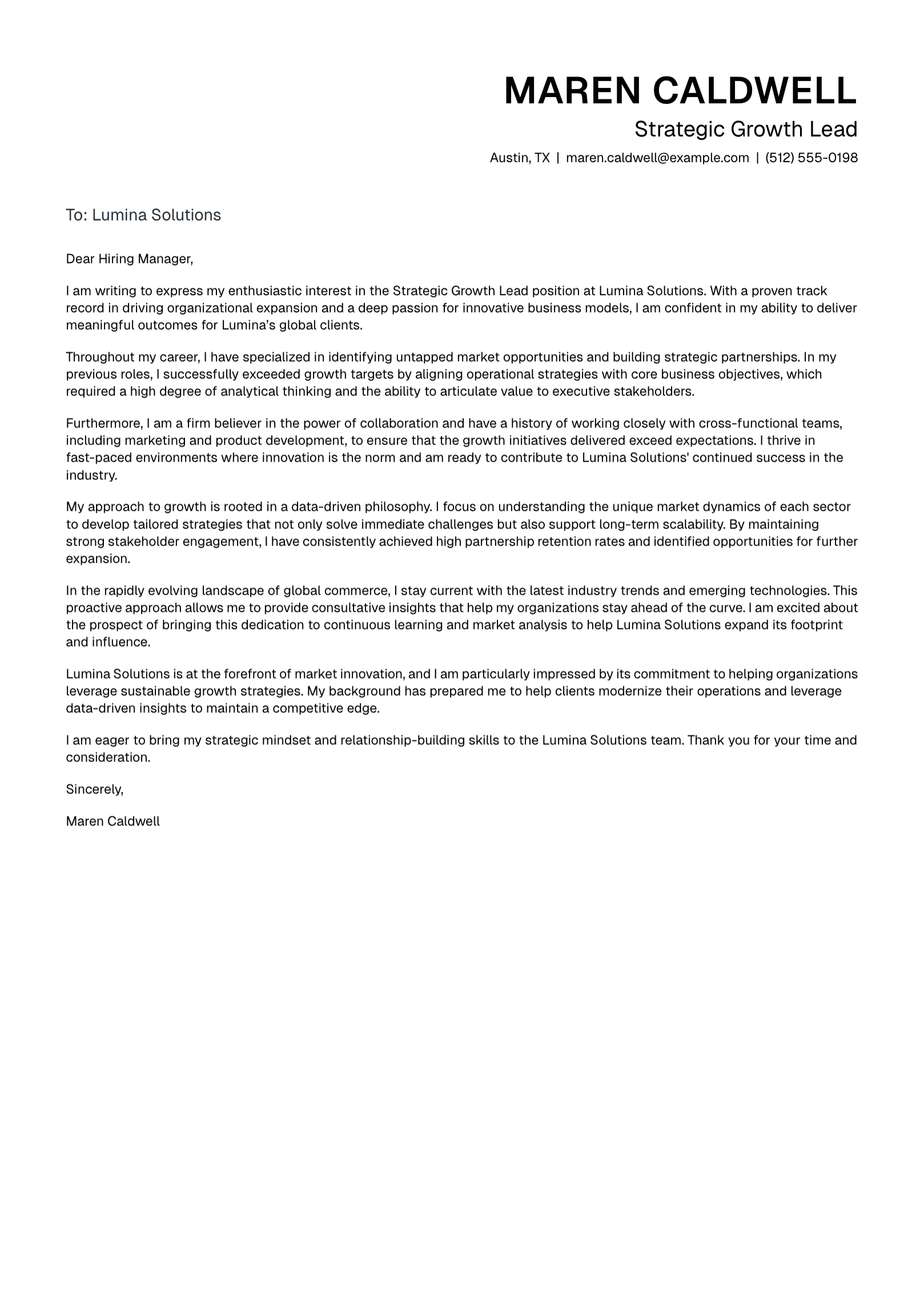
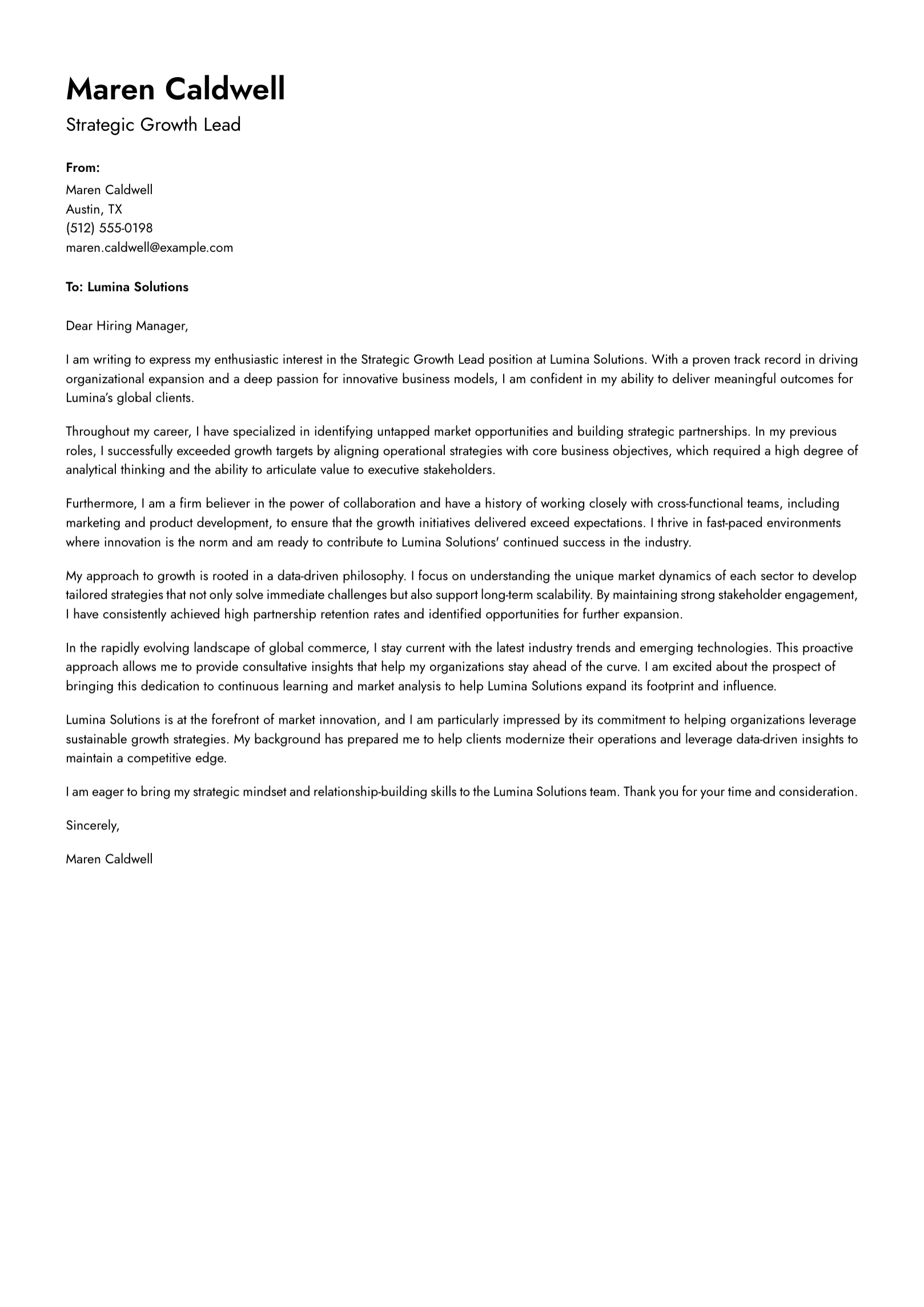
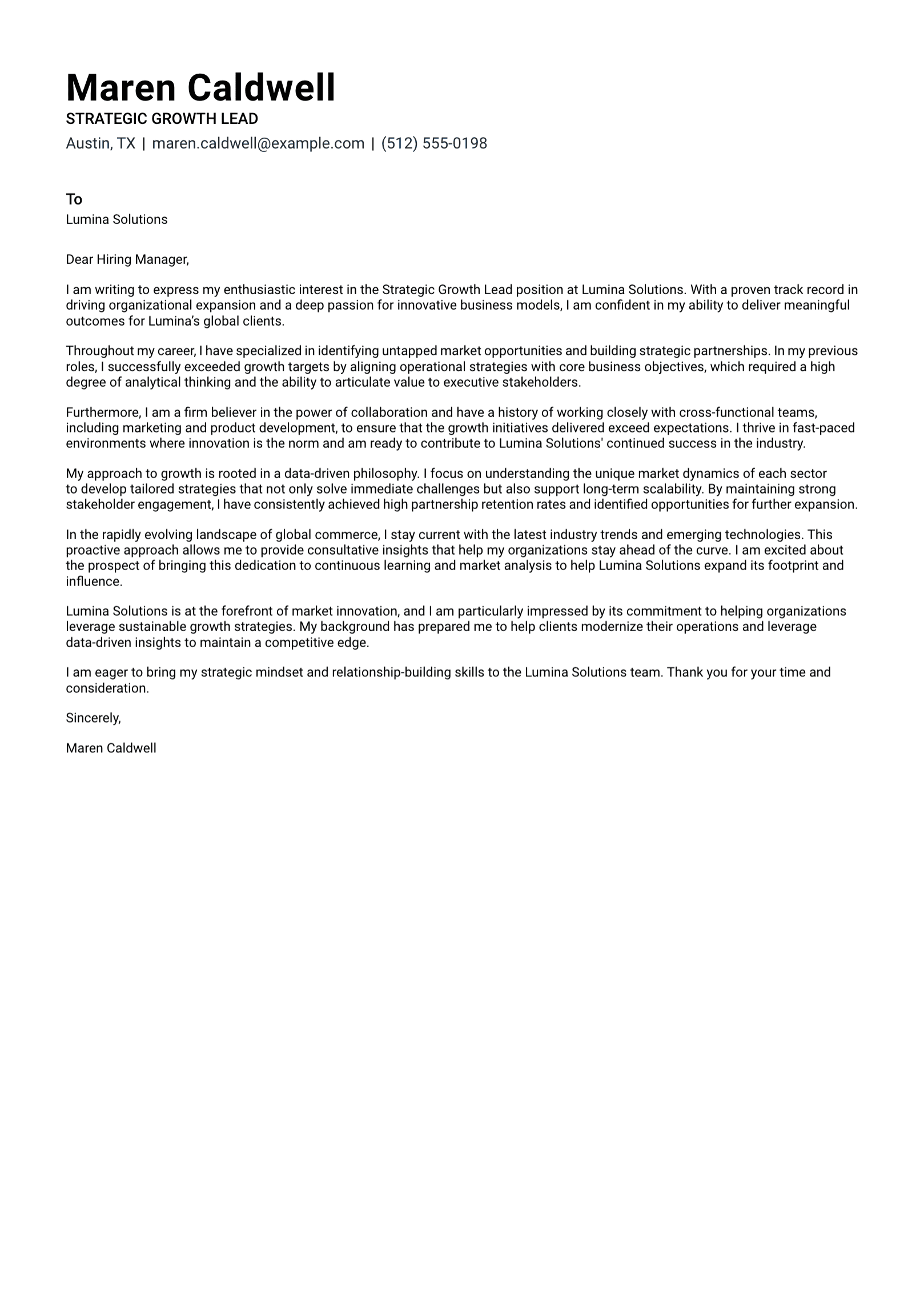
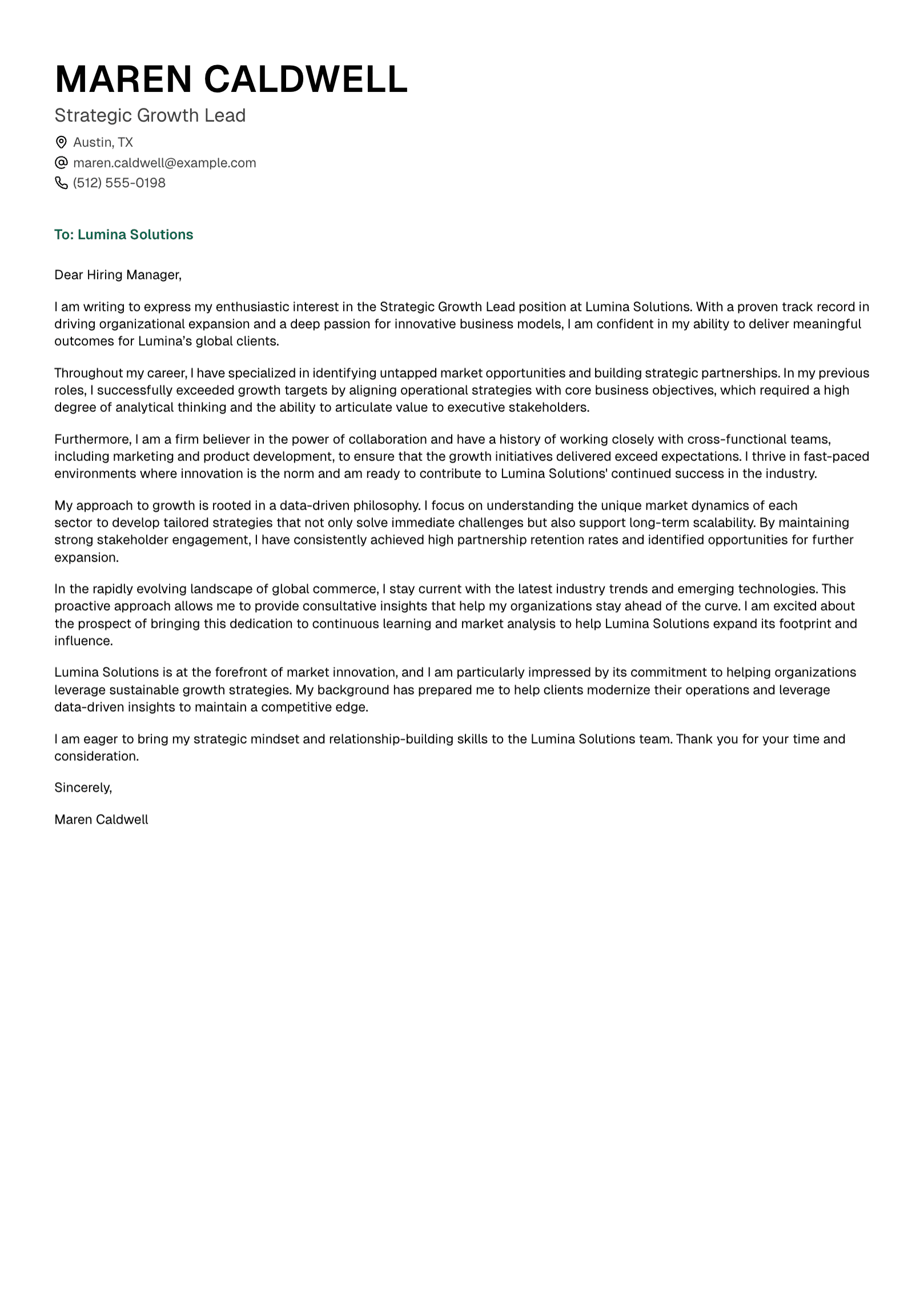
Take a restaurant manager applying for a customer success job at a software company. A letter can open in either of two ways.
I am excited to apply for the Customer Success Manager position. With strong communication skills and a proven track record of delivering results, I am confident I would be a valuable addition to your team.
I have managed a 120-seat restaurant for six years, and the part of that job I am best at is the one your posting describes: keeping a customer after something has gone wrong. I am leaving hospitality because my family is moving to Denver in March, and I spent the past year completing a customer success certificate so that the move could also be a change of career.
Underlined: what the resume alone could not tell the reader.
The first could be attached to any application by any candidate. The second answers the two questions a recruiter would have on finding a restaurant manager’s resume in the pile for a software job: why this, and why now. A separate guide covers how to write the rest of the cover letter.
Standard advice adds small employers to the list, on the theory that an owner reads every application personally. The survey evidence is mixed. Resume Genius found that 49% of small businesses, those with fewer than 100 employees, required a cover letter, against 72% of medium-sized and 69% of large companies. Hiring managers at medium and large companies were also more than twice as likely to rate letters “very important”, at 34% against 15%. The same page cites a 2022 survey of technology companies by The Ladders that points the other way, with start-ups the most likely to require a letter. Company size is a poor guide. The posting is a better one.
So is the country. The evidence above is American, and elsewhere the convention can be firmer. In England the government’s National Careers Service tells applicants: “You should always include a cover letter when you apply for a job using a CV.”
What an optional cover letter means in practice
Read literally, “optional” means the employer has set up the form so that an application can be submitted without a letter. Whether the person reading holds the absence against the applicant is a separate matter, and ResumeGo asked about it directly: “Do you punish or deduct points from a candidate who provides no cover letter” when the job does not require one but offers the option? Of the 236 respondents, 26% said they do and 74% said they do not.
Set beside the experiment, that leaves three choices with different costs. Leaving the field blank is acceptable to about three readers in four, on the evidence of one small survey. Pasting in a generic letter is cheap and achieved little in the experiment: 12.5% against 10.7%. Writing a specific one takes time and is the only choice that moved the callback rate much.
| Situation | Cover letter |
|---|---|
| The posting asks for one | Yes: the application is incomplete without it |
| Optional, and the resume leaves a question open | Yes: a short letter that answers it |
| Optional, nothing to add, many applications to send | Blank costs little |
| One-click application with no field for it | No |
| The posting says not to send one | No |
The last two rows need little thought. One-click applications are built around the resume. LinkedIn’s description of Easy Apply mentions the resume, saved answers and skills from the profile, and never mentions a cover letter. Where a form has no field for one, nobody is waiting for it. And where a posting says not to send a letter, sending one shows only that the posting was not read. An application sent by email is a separate case, since the message itself can serve as the letter, and it is covered in the article on how to email a resume.
Back to the empty field
The question posed by the optional field has an answer, then, and it depends on what would go in the field.
If the posting asks for a cover letter, the letter is part of the application and the question is closed. If the field is optional, the job matters, and there is something the resume cannot say, such as a change of field, a gap, a move or the name of a referrer, then four or five specific sentences are worth the time. A chatbot can draft them, though the Freelancer data suggest that the editing matters. If there is nothing to add and the alternative is a paragraph about being excited to apply, the evidence suggests the field can stay empty with little lost.
Recruiters who skip cover letters gave two main reasons: no time, and nothing in the letter that was not already in the resume. An applicant can do nothing about the first. The second is decided by what the letter says.
How UseResume helps
A general-purpose chatbot such as ChatGPT or Claude knows only what is pasted into it. UseResume is an AI resume builder, built specifically for writing resumes, and its cover letter builder writes a draft from the same resume and the job description it is being sent for. The draft therefore starts from the applicant’s own history and the posting in question. Every line can be edited, which matters here, because the reason for a career change or a gap has to come from the person who has it.
Before the letter goes out, the AI content detector gives it an AI score, shows the lines that sound machine-written and suggests fixes. When an application goes by email to a named person, the free application email writer drafts the message.
Create your account and draft the letter for the next posting that asks for one.